Setting Up a Dubai Free Zone Company for Australians Guide
Thinking about a Dubai Free Zone company setup in 2026 while living in Australia? Whether you’re in Brisbane, Sydney or Perth, thousands of Australian entrepreneurs are choosing Dubai’s free zones for 100% ownership, 0–9% corporate tax and fast online registration.
In this step-by-step guide, you’ll learn:
• The real 2025 setup cost
• How long registration takes
• How corporate tax affects free zones
• How to open a UAE bank account
• Whether you need to relocate
You are not alone. Since 2023, applications from Australian entrepreneurs to Dubai’s 30+ free zones have grown by roughly 42 % (source: Dubai FDI statistics). The reasons are clear: 100 % foreign ownership, a 0–9 % corporate tax regime, zero import duty inside the zone, and the ability to run the entire registration online.
This updated 2026 step-by-step guide covers everything you need from choosing the right free zone to opening a UAE corporate bank account , so you can launch your Dubai company from Australia with clarity and compliance.
Important: This guide focuses specifically on setting up a company in a Dubai free zone.
If you want to compare free zone vs mainland or need help choosing the right structure, see our complete company setup guide for Australians.
Free Zone vs Mainland vs Offshore: What’s Changed in 2026?
Before we dive into the process, quickly recap where a free zone sits in the UAE company landscape:
- Mainland (on-shore): You can trade anywhere in the UAE, but you are subject to 9 % corporate tax on profits above AED 375,000 and must rent an office on the mainland.
- Free zone: You keep 100 % ownership and enjoy 0 % tax if you do not earn UAE mainland income (or if you qualify as a “Qualifying Free Zone Person” under the 2023 Corporate Tax Law). A flexi-desk lease inside the zone is enough.
- Offshore (e.g., JAFZA Offshore): No UAE visas and limited banking options. Suitable mainly for holding assets, not for operational businesses.
👉 2026 update: The UAE’s new Corporate Tax has now completed its first assessment year. Most Dubai free zones, including DMCC, DIFC and IFZA, have published clear guidance confirming that free-zone profits derived from outside the UAE remain at 0 % until at least 2030.
Free Zone vs Mainland in Dubai (2026 Comparison)
| Feature | Free Zone | Mainland |
|---|---|---|
| Ownership | 100% foreign | 100% (most sectors) |
| Corporate Tax | 0%–9% | 9% above AED 375k |
| Office Requirement | Flexi desk allowed | Physical office required |
| UAE Market Access | Limited | Full |
Step-by-Step Dubai Free Zone Company Setup for Australians
Step 1: Pick the free zone that matches your activity and budget
Not all zones are created equal. Use the matrix below to shortlist:
| Free Zone | Key Sectors | 2025 Licence Cost (AED) | Visa Quota Included | Turn-around Time |
|---|---|---|---|---|
| DMCC (JLT) | Crypto, commodities, trade | 38,000 | 1 | 7–10 days |
| IFZA (Dubai Silicon Oasis) | E-commerce, consulting | 14,900 | 0 (add-on) | 2–5 days |
| Dubai South | Logistics, aviation | 25,000 | 2 | 5–7 days |
| DIFC | Finance, fintech | 52,000 + regulatory fees | 4 | 4–8 weeks |
| Meydan Free Zone | Media, professional services | 13,500 | 0 | 1–3 days |
Australian solo consultants often start with IFZA or Meydan because of low set-up fees and fully digital onboarding.
Step 2: Secure your trade name & decide licence activities
Reserve three proposed names online via the free-zone portal. Make sure the name:
- doesn’t contain “bank”, “insurance”, or other regulated terms
- is not identical to an existing UAE entity (check on the Ministry of Economy portal)
- ends with the legal suffix “FZ-LLC”
Meanwhile, select the business activities that will appear on the licence. A consulting license, for example, lets you offer management, marketing and HR advisory under one umbrella.
Step 3: Submit KYC documents
Most zones now accept high-resolution scans. Typically required:
- Colour passport copy (valid ≥ 6 months)
- Recent passport photo (white background)
- Utility bill or bank statement (≤ 3 months old)
- CV or LinkedIn profile (certain zones only)
- For corporate shareholders: ASIC company extract + board resolution apostilled
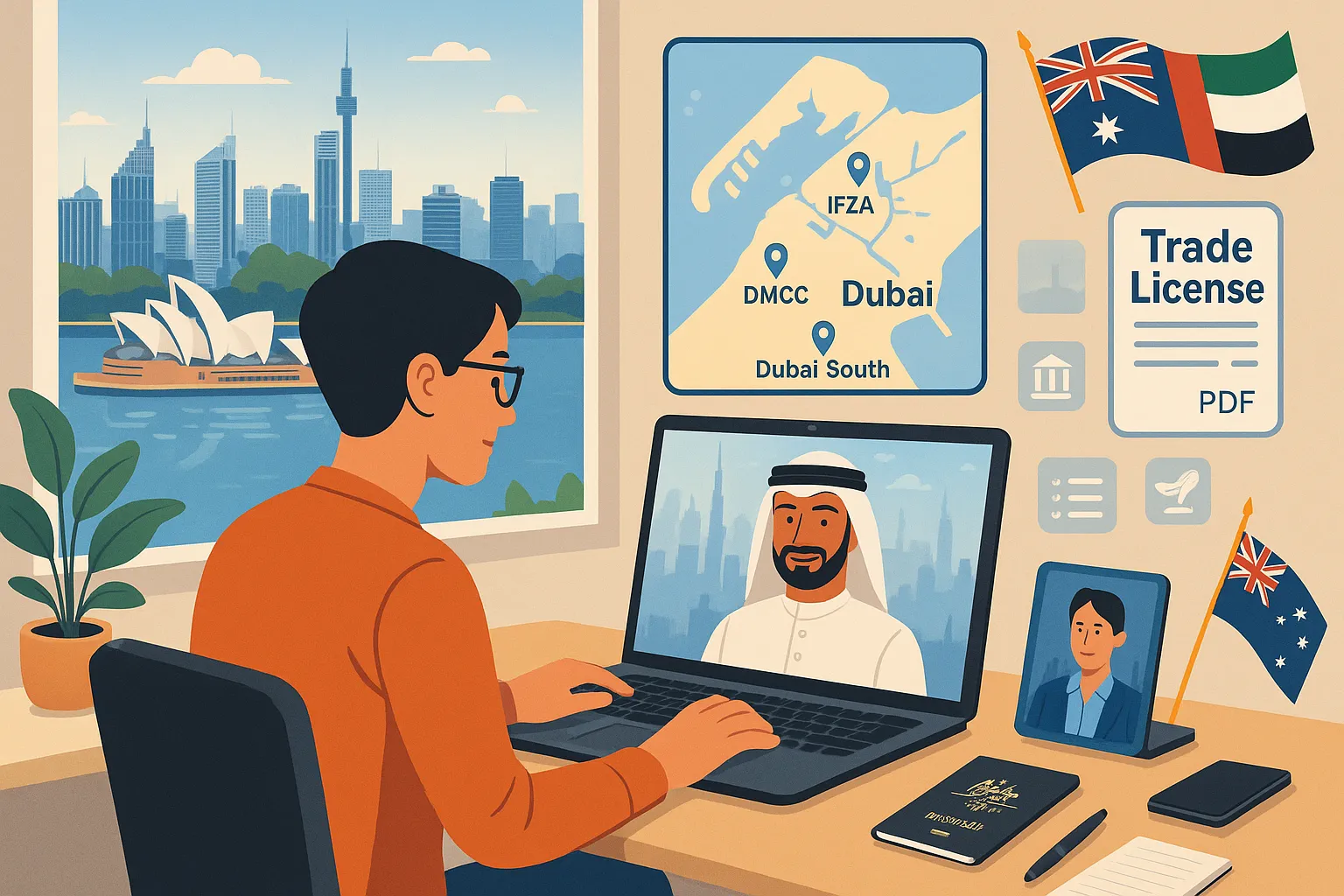
Dubai Invest walks clients through document notarisation and can arrange remote video verification accepted by IFZA and Meydan.
Step 4: Sign the incorporation paperwork electronically
In 2025, wet-ink signatures have almost disappeared. You’ll receive:
- Articles of Association
- Board Resolution
- Bank Introduction Letter
Sign via DocuSign; the free zone will issue the Trade Licence and Certificate of Formation—typically emailed as encrypted PDFs.
Step 5 : Lease your workspace (even if it’s virtual)
For visa eligibility, you need at least a Flexi-Desk lease. Pricing ranges from AED 6,000 to 15,000 a year. You can upgrade to a private office once revenue grows.
Step 6 : Apply for your UAE residence visa (optional but recommended)
A licence alone does not grant residency. The standard package:
- Establishment Card – the company’s immigration file (2–3 days)
- Entry Permit – issued electronically; you can activate it on arrival
- Medical & Emirates ID – biometrics, blood test, chest X-ray
- Visa stamping – now embedded in the Emirates ID, no passport sticker
Total timeline if you fly in: 5–7 working days. Alternatively, use the new UAE Smart Visit Visa to complete medicals on a short trip and return to Australia while the ID is processed.
Step 7: Open a corporate bank account
Banking remains the trickiest part for foreign-owned SMEs. In 2025 you have three realistic routes:
- Tier-1 local banks (Emirates NBD, ADCB): deposit > AED 150k, in-person signatory visit required.
- Digital free-zone banks such as Wio Business and Zand: 100 % app-based, no minimum balance, multicurrency cards.
- International banks with Australian presence (HSBC, Standard Chartered): open in Dubai, but link to your AU relationship manager.
Dubai Invest pre-qualifies your profile to save rejections and arranges a dedicated bank meeting slot within 48 hours of licence issuance.
Can Australians Open a Dubai Business Bank Account Remotely in 2026?
Yes — but approval depends on your business model, expected turnover and compliance profile.
In 2026, digital UAE banks like Wio Business and Zand allow app-based onboarding for many free zone companies. However, Tier-1 banks such as Emirates NBD and ADCB usually require at least one in-person visit.
Australian founders without UAE residency may face additional due diligence checks under AML regulations.
Step 8 : Meet ongoing compliance
- Bookkeeping & annual audit: required in most free zones once revenue crosses AED 5 million or after 18 months of activity.
- Economic Substance Regulation (ESR): submit notification within six months of year-end; most consulting companies fall outside Relevant Activities but must still file.
- Corporate tax registration: free-zone entities must register even if they expect a 0 % rate. The first tax return covering FY 2025 is due in 2026.
- Ultimate Beneficial Owner (UBO) register: notify changes within 15 days.
Failing to comply leads to fines up to AED 50,000 per offence.
How Long Does Dubai Free Zone Company Setup Take in 2026?
For Australian founders, the realistic 2026 timeline looks like this:
• Trade licence approval: 2–10 business days
• Corporate bank account opening: 2–4 weeks
• UAE residence visa processing: 5–7 working days (if visiting UAE)
• Corporate tax registration: Within 3 months of incorporation
Most Australians complete the full setup within 3–6 weeks, depending on banking approval speed.
Dubai Free Zone Company Setup Cost in 2026 (AUD)
In 2026, the cost of setting up a Dubai free zone company ranges from approximately AED 13,500 to AED 52,000, depending on the free zone, business activity, number of visas and office requirements. Australian founders operating remotely can reduce first-year costs by skipping residence visas.
| Item | Low-cost Zone | Premium Zone |
|---|---|---|
| Licence (1 activity) | $6,400 | $14,800 |
| Flexi-desk lease | $2,500 | $6,000 |
| Establishment card | $850 | $850 |
| 2-year visa (optional) | $1,950 | $1,950 |
| Medical & ID | $800 | $800 |
| Total first-year | $12,500 | $24,400 |
AUD figures converted at 1 AUD = 2.45 AED (January 2026 average). Expect a 20–25 % lower spend if you skip the residence visa and operate remotely.
Five pitfalls Aussies should avoid
- Using a UAE PO box as your “registered office”. Most Australian banks and the ATO require a physical address for substance testing. Opt for a desk lease with a street address.
- Choosing the wrong activity code. If you plan to sell digital courses, select “E-Learning Provider” rather than generic “Management Consultancy” to avoid permit issues later.
- Mixing Mainland revenue without planning for tax. If more than 5 % of turnover comes from UAE clients, you may lose the 0 % corporate tax benefit.
- Booking travel during Ramadan or public holidays. Government services slow down; build a two-week buffer.
- Opening a personal account first. UAE banks flag mismatched inflows; secure the corporate account first, then personal.
How Dubai Invest streamlines the whole journey
Setting up alone means juggling at least six different UAE portals and providers. Dubai Invest does the heavy lifting:
- Recommends the best free zone for your sector and budget
- Pre-reviews documents to avoid rejection (saving an average 10 business days)
- Provides an Australian migration lawyer to advise on tax residency implications
- Books your Emirates ID, medical and bank meeting in one synchronized itinerary
- Handles annual compliance so you stay penalty-free
In short, we let you focus on getting clients, not red tape.
Ready to turn your Dubai expansion into reality? Book a free 30-minute strategy call today:
https://dubaiinvest.com.au/contact
Frequently Asked Questions
Does the UAE have a double-tax treaty with Australia?
No. However, because most free-zone profits are taxed at 0 %, you only declare foreign income in your Australian return (ATO section 23AG no longer applies). Speak with a cross-border tax advisor.
How much does it cost to set up a Dubai Free Zone company in 2026?
Costs start from around AED 13,500 (approx. AUD 6,400) for entry-level zones like Meydan or IFZA, and can exceed AED 50,000 for regulated zones such as DIFC.
Is a Dubai Free Zone company still tax-free in 2026?
Free zone companies can qualify for 0% corporate tax if they meet the “Qualifying Free Zone Person” conditions and do not generate significant mainland UAE income. Otherwise, 9% applies above AED 375,000 profit.
Can I live in Australia and run a Dubai Free Zone company?
Yes. Many Australians operate remotely. However, Australian tax residency rules may still apply depending on your circumstances.