
Dubai vs Singapore Offshore Hub for SMEs Comparison Guide
Expanding offshore in 2025: why the choice often comes down to Dubai or Singapore
Australian founders have never had so many reasons to open a second base outside the country: a slipping AUD, talent shortages at home, and customers scattered from Riyadh to Jakarta. Two cities keep popping up in boardroom conversations—Dubai and Singapore. Both are marketed as zero-red-tape, tax-efficient, business-friendly hubs, but they are very different creatures once you scratch the surface.
This deep-dive weighs the pros and cons of each jurisdiction through the lens of an Australian small-to-medium enterprise (SME) looking to scale internationally in 2025. We’ll compare them across nine decision factors, share real-world costings, and finish with a quick decision matrix you can apply to your own expansion plan.

1. Tax environment and incentives
| Criterion | Dubai (UAE) | Singapore |
|---|---|---|
| Headline corporate tax | 0% inside qualifying Free Zones; 9% mainland since 2023 for profits above AED 375k (≈ A$155k) | 17% standard rate; partial exemption brings 8.5% on first S$200k (≈ A$225k) of profits |
| Dividend / capital gains tax | 0% | 0% on foreign-sourced dividends; no CGT |
| GST / VAT | 5% VAT (most Free Zones treat exports as zero-rated) | 9% GST from Jan 2025 |
| Tax treaties with Australia | No bilateral treaty (but relief often available via structured routing) | Comprehensive DTA in force since 1969, revised 2010 |
Take-away: If you will book most revenue outside the UAE, a Dubai Free Zone company can still deliver a genuine 0% effective rate, provided you meet the “qualifying income” tests. Singapore’s regime is less headline-grabbing, yet still nimble thanks to automatic partial exemptions and R&D rebates of up to 400% on eligible spend.
2. Incorporation speed, cost and red tape
- Dubai: As little as five working days in high-volume Free Zones like IFZA or DMCC. All-in packages (licence, lease, establishment card, first visa) range from A$8,000 to A$15,000 for a single-shareholder trading entity. Full remote setup—including e-signatures and video KYC—became standard after 2024 rule changes.
- Singapore: Digital incorporation via ACRA’s BizFile portal is famously quick (often <24 hrs once KYC is approved). Budget A$2,500–A$5,000 for registration plus a local company secretary. No physical office lease is compulsory; a virtual registered address suffices.
Compliance overhead diverges later: Singapore demands audited accounts once annual turnover exceeds S$10 million. Dubai Free Zones still allow unaudited submissions unless you top AED 50 million.
3. Banking access and currency considerations
- The UAE dirham is pegged to the US dollar, reducing FX volatility for exports invoiced in USD.
- Singapore dollar floats freely and is regarded as a regional safe-haven; downside is exposure when AUD/SGD swings.
Opening a corporate bank account is a headache in both cities post-AML crack-downs, but anecdotal timelines differ:
- Dubai: 4–6 weeks typical with Emirates NBD or FAB; fintech alternatives (Wio, Mashreq NeoBiz) now onboard Free Zone entities in <10 days.
- Singapore: 1–2 weeks if you bank with the “big three” (DBS, UOB, OCBC); Airwallex and Wise offer same-day virtual IBANs but won’t satisfy all regulators.
4. Talent pool and labour regulations
- Dubai hosts 200+ nationalities. Costs for mid-level roles (e.g., software engineer, A$75k-equivalent) sit between Sydney and Kuala Lumpur. Employment contracts can be unlimited or fixed-term; severance is governed by end-of-service gratuity rather than compulsory super.
- Singapore graduates rank high on global STEM indices, but hiring foreigners now requires the Complementarity Assessment Framework (COMPASS). Expect to pay premiums: A$120k for the same engineer is common. Mandatory CPF contributions (up to 17% employer) stack on top.
Visa processing times, though, tilt towards Dubai: a three-year employment visa can be issued in 5–10 days once medicals clear; Singapore Employment Passes are taking 4–6 weeks in 2025.
5. Market access and geographic advantage
- Dubai places you within eight hours’ flight of two-thirds of the world’s population, making it a natural hub for MENA, Central Asia and, increasingly, Africa.
- Singapore offers frictionless routes into ASEAN’s 680 million-strong consumer base and deep supply-chain ties to China.
If your growth thesis involves e-commerce into Saudi Arabia or logistics across the Red Sea, Dubai wins hands-down. Selling SaaS subscriptions into Indonesia? Singapore’s bilingual bureaucracy and regional data centres may edge it.
6. Sector-specific ecosystems
- FinTech / Web3: Dubai’s VARA framework (introduced 2023) issues bespoke licences to virtual-asset players, while DMCC’s Crypto Centre hosts 550+ startups. Singapore, wary after local exchange collapses, has tightened MAS guidelines, making retail-facing crypto harder but institutional DeFi easier.
- Med-tech & Biotech: Singapore’s Biopolis cluster, A*STAR grants and proximity to world-class clinical research can’t be matched by the UAE yet.
- Logistics & e-commerce: Dubai’s JAFZA and EZDubai free zones provide bonded warehousing within 15 minutes of the world’s No. 1 cargo airport. Perfect for DDP-style shipping into GCC markets where duties are low.
7. Intellectual property & dispute resolution
Singapore ranks No. 2 globally for IP protection (WEF 2024). Contracts default to English common law, and the Singapore International Arbitration Centre is widely respected.
The UAE re-worked its arbitration law in 2024, aligning more closely with UNCITRAL, and DIFC Courts operate under common law too. Still, enforcement in onshore UAE courts can feel opaque to newcomers. Many Australian CEOs opt for DIFC-LCIA arbitration clauses or, ironically, seat disputes in Singapore even when based in Dubai.
8. Lifestyle, taxes on individuals and family relocation
- Personal income tax remains 0% in the UAE. Payroll deductions are limited to optional insurance schemes. High-end rentals in Dubai climbed 15% YoY in 2024 but still average 30–40% below equivalent CBD apartments in Sydney.
- Singapore levies progressive resident income tax (up to 24% on income above S$1 million), yet offers double-tax treaties to credit Australian taxes if you remain Australian-resident. School fees and rents, however, eat budgets fast (median three-bed condo: A$8,900 per month in 2025).
Visa schemes have converged:
- UAE Golden Visa (10 yrs) from AED 2 million property purchase or AED 2 million bank deposit.
- Singapore Global Investor Programme (5-yr PR) from S$10 million investment in a new entity or fund.
9. ESG and reputation factors
Investors concerned with ESG reporting often perceive Singapore as the more transparent jurisdiction thanks to compulsory sustainability reporting for mainboard firms and clear anti-corruption rankings. Dubai has caught up with CSRD-style guidelines for free-zone PLCs, but rollout is voluntary for most SMEs.
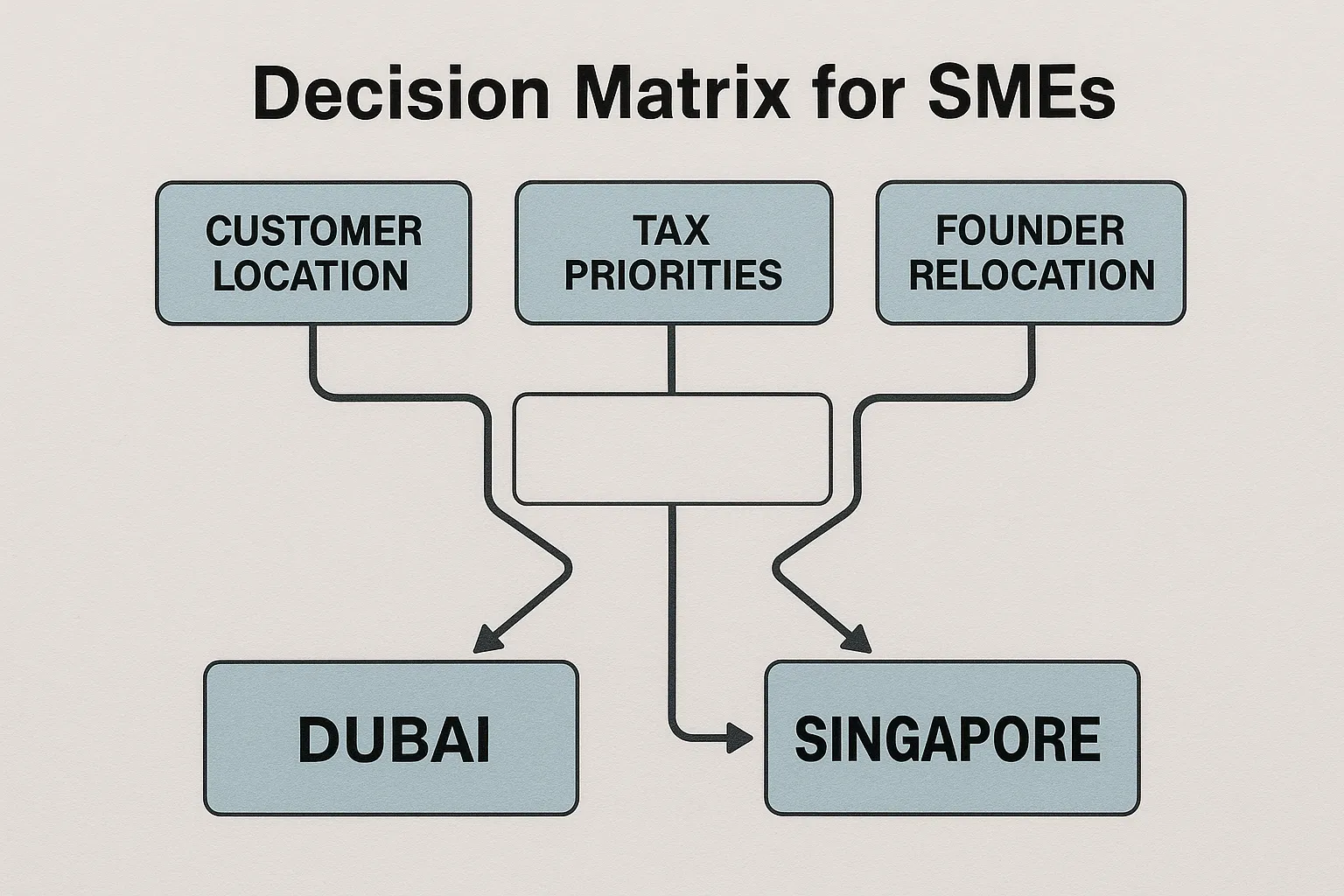
Quick decision matrix for Australian SMEs (2025 edition)
Answer the three questions below to see which hub likely fits your roadmap:
- Where are your first two offshore customer segments?
- GCC / Africa / South Asia → Dubai
- ASEAN / North Asia → Singapore
- Are you targeting a 0% corporate tax outcome with less than A$150k local profit?
- Yes → Dubai Free Zone
- No, we’ll re-invest in R&D rebates → Singapore
- Will you relocate founders & families?
- Yes, need English-curriculum schools and outdoor lifestyle → Dubai (cheaper)
- Yes, need top Asian schools and green city → Singapore
- No relocation → pick the jurisdiction nearest customers
If your answers split, you’re in the grey zone—time to model both scenarios side-by-side.
Cost snapshot (AUD, mid-2025)
| Item | Dubai Free Zone | Singapore Pvt Ltd |
|---|---|---|
| Incorporation package (year 1) | $9,500 | $3,800 |
| Annual licence / secretary renewal (year 2+) | $5,700 | $2,500 |
| Corporate bank setup | $1,500 | $1,200 |
| Co-working desk (monthly) | $650 | $900 |
| Two employment visas / passes (all-in) | $6,400 | $7,800 |
Note: Figures are median quotes from service providers surveyed in June 2025; they exclude optional health insurance and audit fees.
Frequently asked questions
Can I open one company in Singapore and a branch in Dubai (or vice-versa)?
Absolutely. Many e-commerce brands warehouse in Dubai (for zero-duty GCC shipping) and hold IP in Singapore for stronger legal protection.
Will a Dubai Free Zone entity trigger Australian CFC rules?
Potentially yes, especially if management & control stays in Australia. Work with a tax adviser to ensure genuine foreign business premises and active income tests are satisfied.
Is it easier to raise venture capital in Singapore?
Yes, most Asia-Pacific VC funds are structured under MAS oversight, but Dubai’s VC scene is catching up fast—the DIFC Innovation Hub counted 850+ funded startups by May 2025.
Bottom line: match the hub to your growth equation, not the headlines
Both cities tick the big-picture boxes—stable politics, world-class airports, English-language contracts—but the nuances above decide whether you spend thousands optimising tax or months chasing the wrong customer base.
If your roadmap is GCC-centric, capital-light and you value 0% personal tax, Dubai deserves first pass. ASEAN-facing deep-tech or biotech plays may still gravitate naturally to Singapore.
Not sure which path sings to your numbers? Book a complimentary strategy call with our Australian-based consultants. We’ll run the cash-flow models and even arrange remote incorporations should Dubai prove to be your winning hub.