Launching in Dubai is exciting but the sheer number of licence options can feel like alphabet soup—DED LLCs, DMCC FZ-LLCs, IFZA FZE and more. Before you wade into paperwork, you need a crystal-clear answer to one question: should you register on the mainland or in a free zone? This decision shapes everything from market reach to taxes and visas, so it pays to slow down, compare and consult.
Why the Mainland vs Free Zone Question Matters in 2025
Dubai’s corporate-tax era (9 percent on profits above AED 375,000), stricter Economic Substance Regulations and a rush of new Australian founders mean the old rule of thumb—“pick any free zone, it’s tax-free”—is outdated. Choosing the wrong jurisdiction can:
- Block you from tendering for lucrative on-shore contracts.
- Create hidden VAT, banking and payroll hurdles.
- Jeopardise future tax relief under the Australia–UAE treaty.
That’s why business setup in Dubai now starts with a forensic assessment, not a one-size-fits-all package.
Mainland Snapshot
| Factor | Mainland LLC (DED) |
|---|---|
| Foreign ownership | 100 percent allowed for most activities, but strategic sectors still need a local partner or agent |
| Market access | Full UAE market plus government tenders |
| Corporate tax | 0–9 percent depending on profit and activity |
| Office requirement | Physical office (Ejari) mandatory |
| Typical first-year cost (AUD) | $22k–$35k including office and visas |
| Visa quota | Starts at 2–4, scales with office size |
When Mainland Wins
- Selling inside the UAE – retail, e-commerce fulfilment or B2B services to local clients.
- Government contracts – defence, energy or infrastructure deals require mainland trade licences.
- Large payrolls – mainland entities handle unlimited UAE staff with fewer secondment hoops.
Free Zone Snapshot
| Factor | Free Zone FZ-LLC |
|---|---|
| Foreign ownership | 100 percent |
| Market access | Within zone & internationally. On-shore trade via distributor or dual licence |
| Corporate tax | 0 percent on qualifying income till 2071 in selected zones |
| Office requirement | Flexi desk often accepted |
| Typical first-year cost (AUD) | $8k–$18k depending on zone and visas |
| Visa quota | 1–6 on flexi desks, more with offices |
When Free Zones Shine
- Export-oriented businesses – SaaS, consultancy, import-re-export and holding companies.
- IP protection – DIFC and Dubai Silicon Oasis offer common-law courts for tech and fintech founders.
- Cost efficiency – start lean with a flexi-desk, digital KYC and no annual audits in some zones.
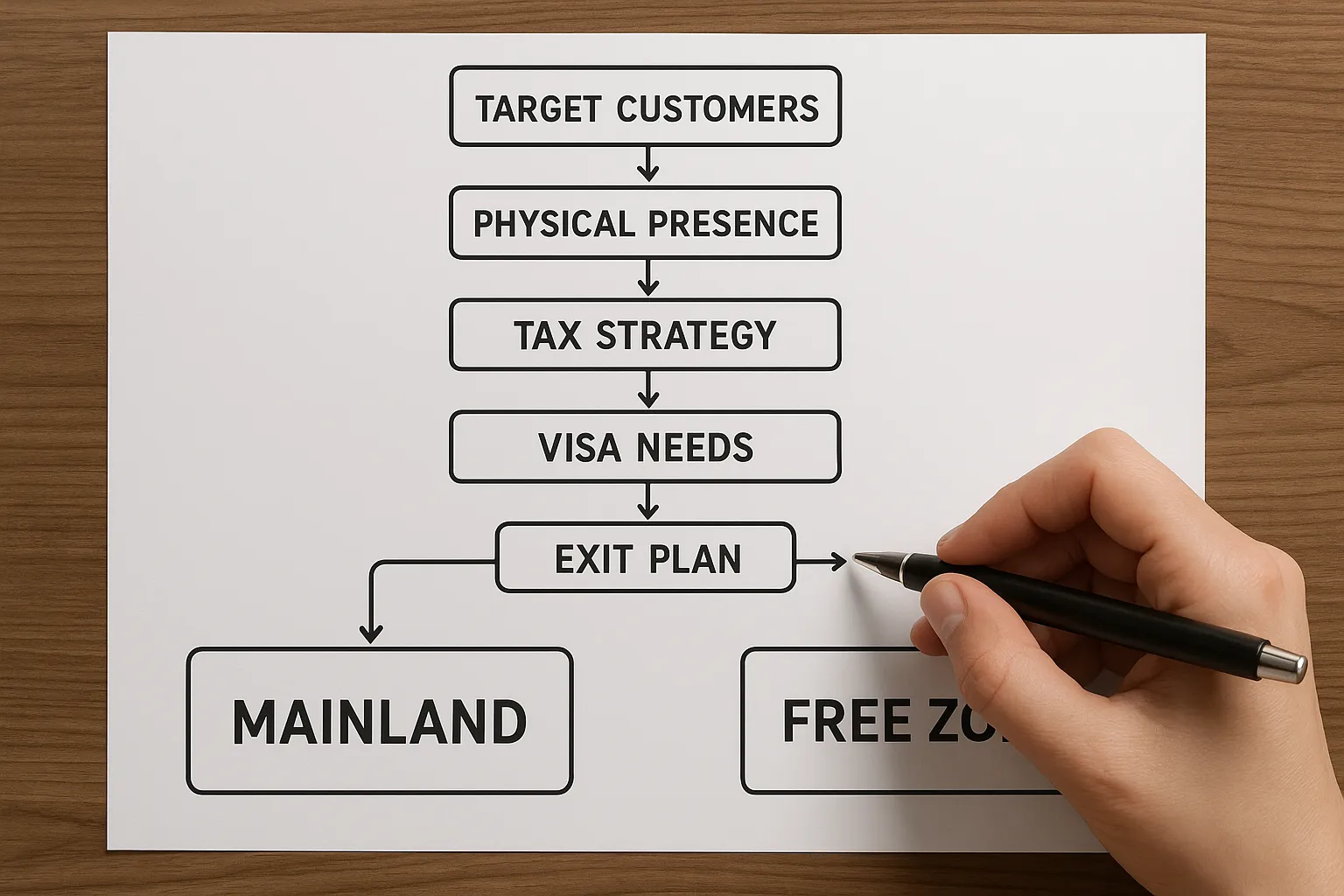
Five Decision Filters to Apply Before You File
1. Customer Geography & Revenue Source
Map your first 24 months of revenue. If 70 percent will come from UAE-based clients or POS terminals, a mainland licence avoids distributor mark-ups and dual-licence fees. Pure-play exporters can stay lean in a free zone.
2. Corporate-Tax Strategy
Only income derived from qualifying free-zone activities (HQ, holding, distribution outside UAE) stays at 0 percent. A mainland LLC can still benefit from the small-business relief band but crosses the 9 percent threshold sooner. A hybrid—free-zone holding company with a mainland branch—often scores the best of both worlds.
3. Visa and Hiring Roadmap
Free zones cap visas per desk; adding headcount means upgrading to a larger office. Planning a 20-person sales team? Budget AED 80–120 per sq ft on the mainland instead.
4. Banking Appetite
Emirati banks continue to de-risk free-zone entities with no UAE revenue. If rapid account opening is mission-critical, a mainland entity with local invoices reduces compliance friction.
5. Exit & Investor Expectations
Australian venture funds familiar with DIFC courts may insist on that jurisdiction. Trade buyers of FMCG brands, however, prefer mainland entities with nationwide distribution rights.
Consultation Beats Guesswork
Jomon, Dubai Invest’s principal consultant, has spent 12 years structuring companies from DIFC fintech startups to Al Quoz manufacturing LLCs. He knows which zone director signatures a bank officer will reject and which mainland activities quietly require extra approvals. Booking a 30-minute strategy call can save you thousands in re-licensing costs and months of delays.
“The most expensive mistake I see Aussie founders make is picking a zone on price alone,” Jomon notes. “Real spending starts when you discover your visa quota is full or a client won’t sign unless you’re onshore.”
Key Takeaways
- Mainland licences offer unrestricted UAE market access, higher compliance and cost.
- Free zones give 100 percent foreign ownership, lower setup fees and potential 0 percent corporate tax on qualifying income.
- Map revenue, hiring, tax and exit plans first—there is no universal “best”.
- Early, personalised advice saves more than DIY comparisons.
Ready to turn clarity into action? Contact Dubai Invest to start your new business journey and book a one-on-one consultation with Jomon today