
Buying Off-Plan in Dubai: Red Flags Australians Should Watch
Buying off-plan in Dubai can be a smart way to access new stock, flexible payment plans and potential upside before handover. It can also be where Australians lose the most money, because the risk is front-loaded: you pay early, you wait, and the final product is only as good as the developer, the contract, and the regulator’s protections.
If you’re considering an off-plan purchase from Australia in 2026, the goal is not to be “optimistic”, it’s to be verifiable. That’s where a proper consultation becomes valuable. A deal-specific review can help you spot contract traps, unrealistic claims and documentation gaps before you wire a deposit.
At Dubai Invest, our lead consultant Jomon brings both job and business experience on the ground in Dubai, which matters when you’re buying remotely and need reality checks beyond glossy brochures.
Why Australians Are Investing in Dubai Off-Plan Properties
Off-plan property is popular with Australian buyers for a few practical reasons:
- Lower initial cash outlay compared with buying a ready property (often via staged instalments).
- Newer buildings and amenities, which can support rentability if the project is delivered well.
- Access to launch pricing and allocations that may not appear on mainstream portals.
- Potential residency planning, where the property pathway can intersect with longer-term visa goals (this depends on eligibility and should be verified).
The upside is real, but it only materialises when the project is registered, properly escrowed, realistically timed, and the Sales and Purchase Agreement (SPA) is clean.
Key Risks of Buying Off-Plan Property in Dubai
The main off-plan risks for Australians usually fall into five buckets:
- Counterparty risk: the developer’s financial strength and delivery history.
- Regulatory risk: whether the project is properly registered and governed under Dubai Land Department (DLD) and RERA frameworks.
- Contract risk: SPA clauses that shift costs, timelines or cancellation rights away from the buyer.
- Execution risk: construction delays, specification downgrades, or handover issues.
- Currency and cashflow risk: AUD to AED conversion, staged payments, and timing your transfers.
A consultation is most useful when it turns these “generic risks” into a specific yes or no decision on one project, one developer, one contract.
Red Flags Australians Should Watch Before Buying Off-Plan
If any of the following show up, slow down and verify:
- The sales agent pushes you to “book today” without giving you time to review the SPA.
- You’re asked to pay to a personal account, or an account that is not clearly tied to a regulated escrow.
- The project’s registration details are vague, inconsistent, or hard to confirm.
- Marketing focuses heavily on lifestyle hype, but avoids specifics on handover dates, defects liability, service charges, or escrow.
A simple way to think about it: if the project is legitimate, it should be easy to verify.
| Red flag | Why it matters | What a cautious buyer does next |
|---|---|---|
| “Guaranteed ROI” promises | Returns depend on supply, rents, fees, and delivery, guarantees are often marketing language | Request assumptions in writing, model net yield, verify any guarantee terms in the SPA |
| Confusing payment plan milestones | Hidden balloon payments can create funding stress | Map instalments against your AUD cashflow and FX plan |
| Limited developer track record | Higher risk of delays, spec changes, or cancellations | Verify past handovers and complaint patterns, not just brochures |
| Escrow details not transparent | Escrow is a key buyer protection in off-plan | Confirm escrow account exists and payments go to the correct account |
| Contract clauses shifting costs | Fees and variations can erode returns | Get SPA reviewed before signing or paying material funds |
Unrealistic Payment Plans and Guaranteed ROI Claims
Payment plans are one of the biggest reasons Australians consider off-plan, but they’re also one of the easiest places to get misled.
Be cautious when you see:
- “Too good to be true” post-handover plans that hide high instalments after completion.
- Guaranteed ROI claims that are not clearly defined (gross vs net, before or after service charges, management, vacancy and furnishing).
- Rent guarantee programs where the conditions are unclear (unit type restrictions, furnishing requirements, or payout caps).
In a consultation, we typically stress-test the plan by translating each milestone into:
- AED cash required at each date
- Expected AUD cost under conservative FX scenarios
- Total acquisition cost including fees (not just the “unit price”)
Developers With Limited Track Record
Dubai has excellent, established developers and it also has newer players. New is not automatically bad, but it is automatically higher risk.
Red flags include:
- No verifiable history of completed projects that you can inspect (or that can be independently confirmed).
- “Partner” or “affiliate” branding that makes it unclear who is actually responsible for delivery.
- Heavy reliance on influencers and launch events, with limited documentation transparency.
A strong consultation here is less about opinions and more about evidence: what have they delivered, when, and at what standard?
Delays in Construction and Project Delivery
Delays are common in off-plan globally, and Dubai is no exception. The question is whether the SPA and the project status give you reasonable protection and clear options.
Australians should watch for:
- Completion dates that are expressed vaguely, or that include broad “grace periods”.
- Weak clarity on what happens if the project is materially delayed.
- Missing clarity on whether you can resell before handover and under what conditions.
If you want the official frameworks and buyer-facing processes, start with the Dubai Land Department (DLD) resources, then validate the details against your specific project documentation.
Lack of Escrow Account Protection
Escrow is one of the most important concepts in Dubai off-plan.
In general terms, Dubai requires escrow arrangements for many off-plan developments, designed to ring-fence buyer funds for construction-related use. But escrow is not magic. You still need to confirm:
- The project has an escrow account.
- You are paying into the correct account associated with the project.
- Receipts and registration confirmations align with the project.
Never rely on “WhatsApp screenshots” or verbal assurances. Verification is a document exercise.
Hidden Fees and Contract Clauses
Australian buyers often focus on the headline price and miss the clauses that change the economics.
Common issues to review carefully:
- Variation clauses allowing changes to layout, view, size tolerances, or materials.
- Penalty and default clauses that are strict on buyers but flexible on timelines.
- Assignment/resale restrictions (including admin fees and developer approvals).
- Service charge and community fee wording that doesn’t give you a way to estimate net yield.
This is where an experienced Dubai-based consultant can save you real money by flagging items early and coordinating with the right legal professionals for review.
Importance of Checking the Developer’s Past Projects
Past projects are one of the best predictors of your off-plan outcome.
When checking a developer’s history, don’t just look at photos. Look for:
- On-time (or near on-time) delivery patterns
- Build quality consistency across multiple communities
- Post-handover reputation (maintenance responsiveness, defect handling, community management)
If you’re buying from Australia, you can also sanity-check whether demand is real for that building type and location. For investors who plan to lease or resell, marketing capability matters too. For example, if your strategy includes targeting local tenants or buyers via social channels, tools like TokPortal can help brands post TikToks into specific countries to reach real local audiences. That marketing step is optional, but it highlights the bigger point: your exit and leasing assumptions should be practical, not just theoretical.
How to Verify a Dubai Off-Plan Project Legally
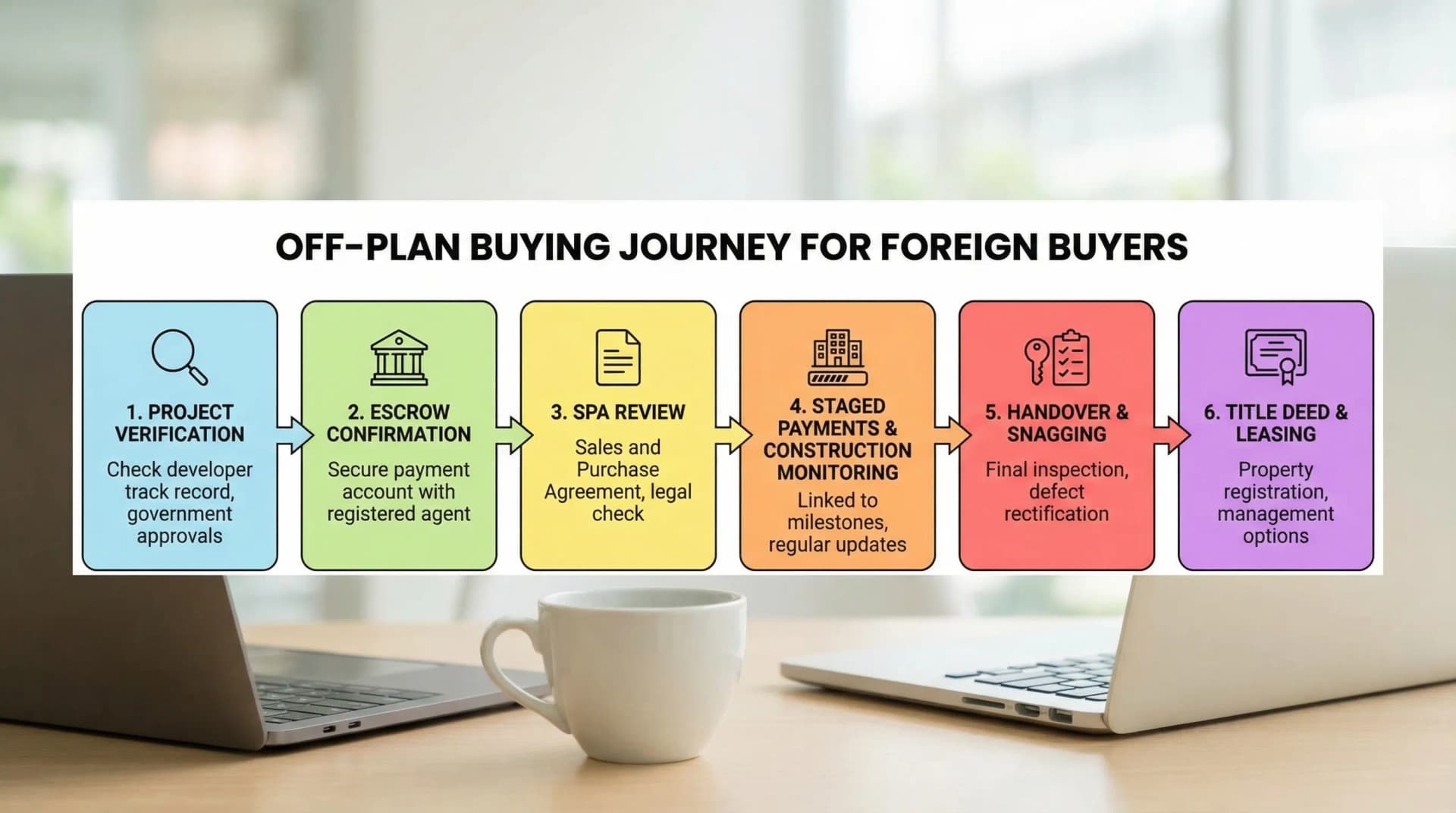
Legal verification is not a single checkbox. It’s a chain:
- Project registration verification
- Developer verification
- Escrow verification
- Sales channel verification (who is authorised to sell)
- Contract verification (SPA terms, timelines, remedies)
For Australians, the biggest mistake is doing 80 percent of the checks, then wiring funds before the last 20 percent is confirmed.
If you need the official regulator context, the DLD and its Real Estate Regulatory Agency are the right starting points. You can begin at the RERA section of Dubai Land Department and then validate the project specifics through your documentation and authorised parties.
Understanding Dubai Land Department and RERA Regulations
DLD is the primary government authority overseeing real estate registration and related processes in Dubai. RERA is the regulatory arm that sets and enforces rules around developers, brokers and aspects of project governance.
From an Australian investor’s perspective, these are the practical takeaways:
- You want registration visibility: the project should be identifiable, not opaque.
- You want regulated money flow: deposits and instalments should go where they are supposed to go.
- You want document alignment: the SPA, receipts, and registration acknowledgements should all match.
A consultation helps translate regulations into a project-level checklist, especially when you’re buying remotely and documentation is being shared across time zones.
Tips for Australians Buying Off-Plan Property Safely
Buying off-plan safely is mostly about sequencing and discipline.
- Do not pay first to “secure the unit” unless you have verified where funds go and what the booking form legally commits you to.
- Insist on written answers, then ensure those answers appear in the SPA where relevant.
- Model the full cost (DLD-related fees, commissions where applicable, service charges, furnishing, management, vacancy buffers).
- Plan your remote execution (Power of Attorney, notarisation, document attestation where needed).
If you want this done properly, book a consultation before you commit funds. It’s easier to prevent a bad deal than to unwind one.
How Currency Exchange Can Impact Australian Investors
Australians often underestimate how much FX can change the economics of an off-plan purchase because payments are staged.
Key realities:
- The AED is widely known to be pegged to the USD, which means AUD to AED risk is heavily influenced by AUD to USD movements.
- Off-plan schedules create multiple conversion points, not one.
- Transfer timing, bank cut-offs and compliance checks can affect whether funds arrive when required.
Risk controls that many investors consider (depending on personal circumstances) include:
- Staging transfers strategically instead of converting everything at once
- Discussing forward contracts or hedging solutions with appropriate providers
- Holding a buffer for FX moves and transfer delays
A deal-level consultation should include an FX plan that matches the payment milestones, not a generic “we’ll figure it out later”.
Questions Australians Should Ask Before Signing an Off-Plan Contract
Before you sign an SPA, you should be able to answer these clearly:
- Is the developer properly registered for this project, and can I verify it through official channels?
- What is the escrow account, and how do I confirm my payments go into the correct escrow?
- Who is the authorised sales channel for this unit (developer direct, authorised broker, or third party)?
- What is the drop-dead completion date, and what remedies exist if handover is materially delayed?
- Can I resell before handover, and what are the fees, approvals and restrictions?
- What exactly is included (appliances, parking, balcony, furnishings), and where is that defined?
- What ongoing fees should I budget for (service charges, community fees, management, utilities setup)?
- What are the consequences if my international transfer arrives late due to compliance or bank processing?
If any answers are vague, that’s not a “small issue”. It’s a signal to pause and get it reviewed.
How DubaiInvest Helps Australians Avoid Off-Plan Property Risks
Dubai Invest supports Australians through the parts of the process that are hardest to manage remotely:
- Project and developer due diligence support (so you’re not relying only on marketing)
- Documentation coordination and checklists, including helping you understand what to request and why
- Remote buyer support across time zones, including practical sequencing before deposits are sent
- Introductions and coordination with relevant third parties where required (for example, conveyancing and compliance support)
- FX and money-transfer guidance aligned to milestone dates
Most importantly, we focus on consultation-led decision-making. Jomon’s Dubai-based job and business experience helps investors pressure-test claims against what actually happens on the ground, from handover realities to contract patterns.
If you’re looking at a specific off-plan deal, you can start by booking a consultation via Dubai Invest.
Final Thoughts on Buying Off-Plan Property in Dubai
Off-plan can work very well for Australians, but the buyers who win tend to be the ones who treat it like underwriting, not like shopping.
Watch the red flags, verify the fundamentals (registration, escrow, authorised sales), and take the SPA seriously. Then, before you send funds or sign anything, get a deal-specific consultation. It’s the simplest way to avoid the most expensive mistakes.