
Complying with the UAE’s Ultimate Beneficial Owner (UBO) rules is no longer just a box-ticking exercise-authorities now use the register to police money-laundering, corporate tax and even property transfers. If you are an investor, founder or director of a UAE entity, ignoring the UBO compliance UAE framework can trigger licence suspension and six-figure fines. Below is a practical guide written for Australian and other foreign stakeholders who need to stay on the right side of the law while doing business in Dubai and the wider Emirates.
What Are UBO Regulations and Why Do They Matter?
The term Ultimate Beneficial Owner refers to the natural person who ultimately owns or controls a company, even if that ownership is hidden behind layers of nominees or offshore structures. The UAE introduced mandatory UBO disclosure through Cabinet Resolution No. 58 of 2020 and subsequent Ministry of Economy (MoE) decisions. Key objectives are:
- Combatting money laundering and terrorist financing
- Increasing transparency for tax authorities (including the new 9 % corporate tax)
- Aligning with Financial Action Task Force (FATF) recommendations, which affect the UAE’s global banking relationships
Because the regulations apply to mainland, free-zone and offshore entities alike, every Australian-owned SPV—whether it holds property, runs an e-commerce store or acts as a family-office vehicle—must maintain an internal UBO register and submit it to the relevant authority.
Failure to comply can lead to administrative penalties ranging from AED 50,000 to AED 1 million, in addition to possible licence suspension or restrictions on new business activity.
Who Qualifies as an Ultimate Beneficial Owner Under UAE Law?
Under Article 5 of the Resolution, a UBO is generally the natural person who:
- Directly or indirectly owns 25 % or more of the company’s share capital or voting rights; or
- Exercises control via the right to appoint or remove the majority of directors or managers; or
- Performs senior management functions if no individual meets the first two tests.
Practical tips for complex structures
- Multiple layers or trusts: Trace ownership through each entity until you reach the individual. If the chain stops at a trust, the trustee is usually the UBO unless the trust deed names a beneficiary with effective control.
- Joint ventures: More than one person can be listed if their combined share or control exceeds 25 %.
- Listed companies: Exempt if listed on a UAE-recognised stock exchange—but their UAE subsidiaries still have to file.
UBO Reporting Requirements and Timelines
| Obligation | Mainland LLC | Free-Zone Company | Offshore IBC (e.g., JAFZA Off-shore) |
|---|---|---|---|
| Create internal UBO register | Within 15 days of incorporation | Within 15 days of incorporation | Within 15 days of incorporation |
| File UBO data with registrar | 60 days after licence issuance or change | 60 days after licence issuance or change | 60 days after licence issuance or change |
| Update changes | Within 15 days of any change | Within 15 days | Within 15 days |
| Annual confirmation | Along with licence renewal | Along with licence renewal | Along with licence renewal |
Sources: Cabinet Resolution No. 58/2020; MoE Circulars 2022-24; free-zone implementing rules 2023.
Penalties for Non-Compliance
| Violation | Fine (AED) | Additional Consequences |
|---|---|---|
| Failure to maintain UBO register | 50,000 | Licence suspension possible |
| Late or inaccurate filing | 20,000–100,000 | Public disclosure of offence |
| Repeated breach within 12 months | Up to 1 million | Mandatory dissolution or manager disqualification |
Penalties for Non-Compliance
| Violation | Fine (AED) | Additional Consequences |
|---|---|---|
| Failure to maintain UBO register | 50,000 | Licence suspension possible |
| Late or inaccurate filing | 20,000–100,000 | Public disclosure of offence |
| Repeated breach within 12 months | Up to 1 million | Mandatory dissolution or manager disqualification |
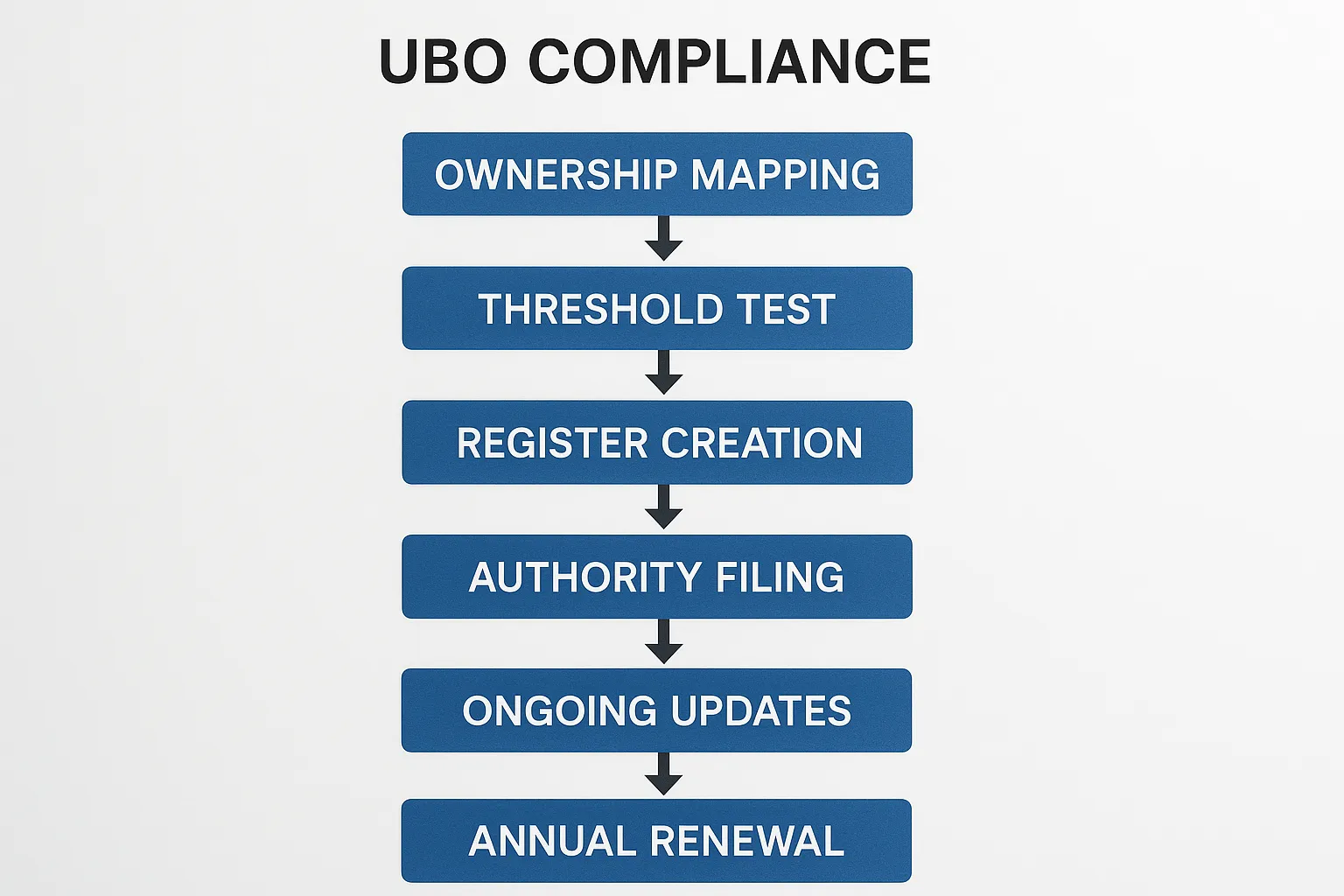
Step-by-Step Guide to UBO Compliance UAE
1. Map Your Ownership Chain
Start with the shareholder register and follow every corporate layer until you reach the natural person(s). Document percentage ownership and control rights at each level.
2. Confirm the Threshold Test
Highlight any individual with 25 % or more equity or control. If nobody meets the threshold, identify the person with ultimate managerial control—usually the general manager or director.
3. Prepare the UBO Register
The register must include:
- Full legal name, nationality and gender
- Passport or Emirates ID number and issue/expiry dates
- Residential address
- Date and basis for becoming a UBO (shareholding, control, senior management)
- Percentage of ownership or description of control
Keep the register at the company’s principal place of business or registered office in the UAE.
4. File With the Relevant Authority
- Mainland LLC: Upload through the MoE/Invest UAE portal.
- Free-zone company: Use the free-zone’s online dashboard (e.g., DMCC Portal, IFZA CRM).
- Offshore entity: Submit to the offshore registrar (e.g., JAFZA Offshore Desk).
Most portals accept PDF templates or direct data entry. Attach passport copies and proof of address where required.
5. Update Promptly
Any change—share transfer, new shareholder, passport renewal—must be reflected within 15 days in both the internal register and the government filing.
6. Renew Annually
At licence renewal, reconfirm that the data is accurate, pay the filing fee (typically AED 350–500) and obtain a fresh compliance certificate.
Real-World Scenarios
Scenario 1: Australian Trading Company in DMCC
- Structure: AU HoldCo → 100 % of DMCC FZ-LLC
- UBO: Two Australian founders each own 50 % of AU HoldCo. Both are listed as UBOs even though the UAE company has only one corporate shareholder.
- Extra step: DMCC also requires Economic Substance and GoAML registration—file them together to avoid duplicate data entry.
Scenario 2: Property SPV Holding a Dubai Marina Apartment
- Structure: BVI company → 30 % owned by Jane (Sydney); 70 % by ABC Family Trust (Jane is sole beneficiary)
- UBO: Jane appears twice in the chain and thus meets the 25 % threshold directly and indirectly—she is the sole UBO.
- Common error: Clients often list the BVI director instead of themselves; this triggers fines during DLD transfer.
Scenario 3: DIFC Fund Manager
- Structure: Publicly listed UK PLC owns 100 % of DIFC-registered subsidiary.
- UBO exemption: The DIFC subsidiary is exempt because the parent trades on the FTSE-100, but it must file a declaration of exemption.
How Dubai Invest Simplifies UBO Compliance
Dubai Invest’s corporate-services team works with both startups and multi-layered holding groups to:
- Perform ownership mapping and determine reportable Ultimate Beneficial Owner rules Dubai thresholds
- Draft and maintain statutory registers compliant with Cabinet Resolution 58/2020
- File initial and ongoing returns with mainland, free-zone and offshore registrars
- Coordinate Economic Substance (ESR) and Anti-Money Laundering (AML) filings to eliminate duplication
- Provide nominee or corporate secretary services where privacy or governance standards demand an extra layer of oversight
If you are already a Dubai Invest real-estate or business-setup client, UBO support can be bundled with your existing service plan so you never miss a deadline.

Stay Compliant—Stay Confident
UBO compliance is now intertwined with banking, tax filings and even property transfers in the UAE. Rather than treating it as a one-off chore, smart founders embed the register into their governance playbook.
Need help mapping complex shareholding layers or filing across multiple zones? Dubai Invest offers end-to-end support—from incorporation to ongoing regulatory filings—so you can focus on growth while we guard your compliance.
Ready for stress-free UBO compliance? Book a complimentary 30-minute consultation with a Dubai Invest advisor today.