
Why Australians Are Investing in Dubai in 2025
The Dubai property market has surged since 2022, fueled by Expo-legacy infrastructure, rapid population growth of over 3.3 million, and investor-friendly regulations. At the same time, tighter lending rules and rising stamp duties in Australia are motivating more investors to invest in Dubai real estate from Australia, seeking stronger returns, tax efficiency, and global portfolio diversification.
Key figures for Q2 2025 (Dubai Land Department):
- Average apartment price growth year-on-year: 11.2 %
- Gross rental yields in prime areas: 7–9 %
- Vacancy rate city-wide: 5.1 % (down from 8 % in 2023)
Add in zero income tax on rental income inside the UAE and 100 % foreign ownership in designated freehold zones, and Dubai becomes hard to ignore.
Freehold vs Leasehold: Where You Can Buy in Dubai
Foreigners—including Australians—can purchase in more than 90 designated freehold communities such as Dubai Marina, Downtown, Jumeirah Village Circle, and emerging hubs like Dubai South. Elsewhere, property is sold on 99-year leasehold. Always confirm the status of a project on the Dubai Land Department (DLD) interactive map
8-Step Guide to Buying Dubai Property from Australia
1. Define Your Strategy
- Income focus: Studios and one-bed apartments in high-demand rental hotspots (e.g., Palm Jumeirah, Business Bay).
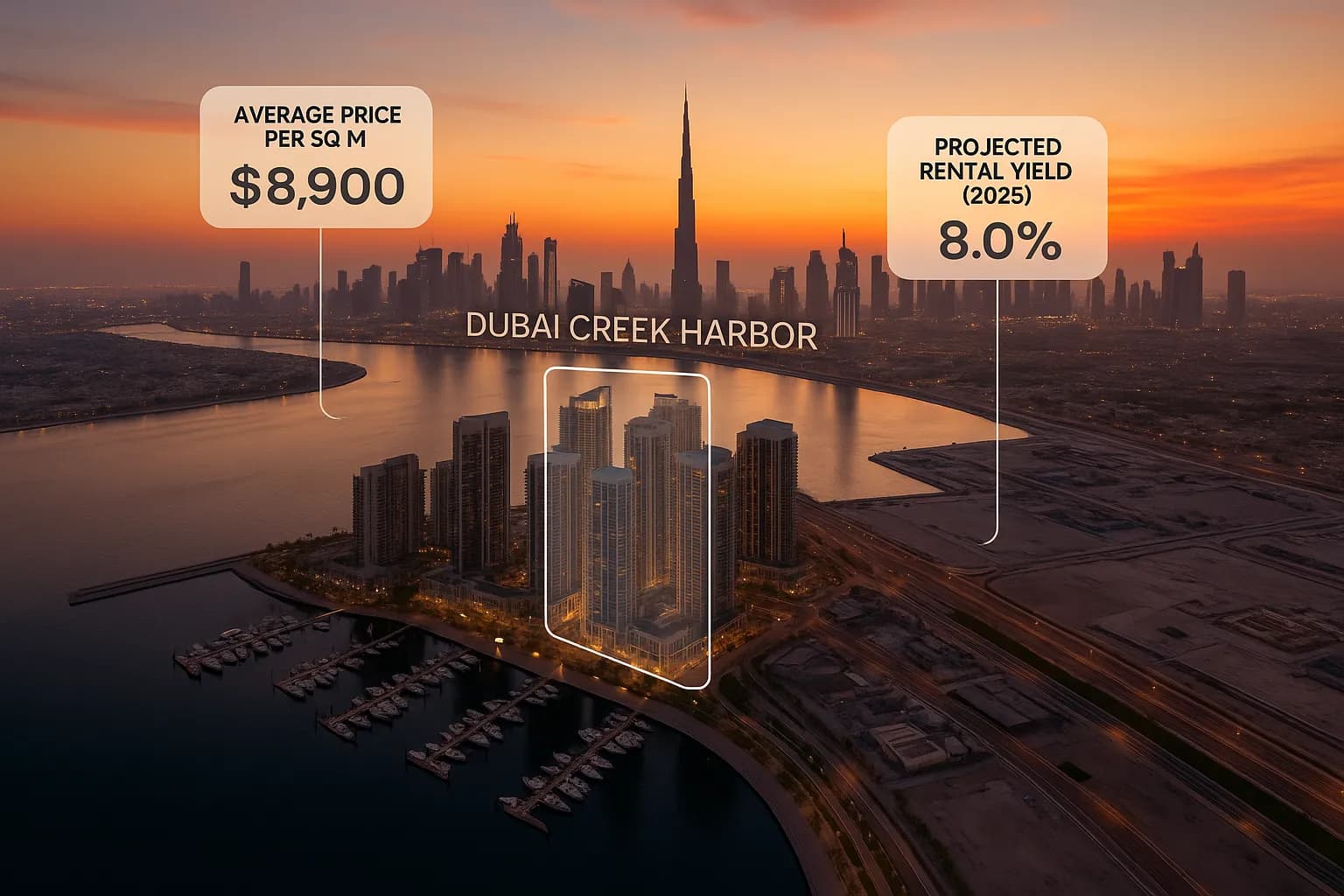
- Capital growth: Off-plan units in emerging master communities like Dubai Creek Harbour.
- Lifestyle hybrid: Villas or branded residences you can occupy during UAE winters and holiday-let the rest of the year.
2. Lock In Your Investment Structure
Option A – Personal name (simplest, no ongoing local reporting). Option B – Free zone company (popular for multiple properties; can sponsor UAE residence visas and eases inheritance planning). Dubai Multi Commodities Centre (DMCC) and Meydan Free Zone are go-to choices.
Tip: A free zone company can often be set up remotely within 7–10 business days with e-signature. Dubai Invest manages all filings and bank introductions on your behalf.
3. Shortlist Developers and Projects
Use a three-filter test:
- Track record: At least three completed projects delivered on time.
- Escrow compliance: Buyer payments must sit in a DLD-monitored escrow account.
- Rental track record: Compare real rental contracts on the RERA Ejari database, not brochure estimates.
Well-known developers with solid reputations include Emaar, Meraas, and Sobha Realty. For boutique, high-yield options look at Samana or Ellington.
4. Secure Financing (or Decide to Go Cash)
Australian banks will not lend on offshore property, but major UAE lenders will finance up to 50–60 %LTV for non-resident Aussies if your income is AUD-denominated. Current expat mortgage rates (June 2025) start at 5.2 % p.a. fixed for three years.
Remote mortgage process:
- Pre-approval via scanned passport and payslips
- Valuation report ordered by the bank (approx. AED 2,500)
- In-principle letter of offer within five working days
Cash buyers avoid bank fees (approx. 1 % of loan), but should still use a regulated escrow transfer.
5. Due Diligence & Contract Stage
- Reservation agreement: Usually AED 20,000–50,000 and refundable for 14 days.
- Sales & Purchase Agreement (SPA): Reviewed by your conveyancing lawyer; contains a payment schedule and hand-over date.
- NOC: Needed if buying a secondary-market property. It confirms the seller has cleared all service fees.
Dubai Invest provides bilingual contract reviews and liaises with the DLD so you never need to leave Australia until hand-over (and even then, it can be handled via Power of Attorney).
6. Transfer & Registration
Registration fee: 4 % of purchase price + AED 580 admin (paid to DLD). Our team books an online Oqood (for off-plan) or Title Deed (for completed units) appointment, accompanies your POA at the transfer centre, and uploads documents to the DLD REST app for instant digital title issuance.
7. Post-Purchase Management
- Hand-over inspection & snagging report
- Ejari rental contract registration
- Furnishing and photo staging
- Ongoing rent collection & service-charge payment
A full-service management plan averages 7–8 % of annual rent, tax-deductible against your Australian assessable income.
8. Exit Strategies
- Capital appreciation flip: Off-plan assignments allowed once 40–60 % of payments completed (varies by developer).
- Long-term hold and refinance: Release equity tax-free in the UAE, then reinvest.
- Golden Visa route: Spend at least AED 2 million (≈ AUD 820,000) to qualify for a 10-year renewable residency.
Tax & Currency Tips for Australian Investors
- Australian Tax Office (ATO) reporting: Rental income must be declared, but you can deduct interest, management fees and depreciation allowances. Capital gains on Dubai property are subject to Australian CGT using standard discount rules (50 % discount after one year for individuals).
- Double Tax Agreement: The UAE-Australia DTA (effective since 2023) gives Australia the right to tax the income, while Dubai levies none—so no double taxation.
- Foreign exchange: AED is pegged to USD (3.6725). Lock rates via a forward contract when transferring AUD to AED to protect your budget from US-rate swings.
Typical Costs When Buying Property in Dubai
| Item | Cost | % of Price |
|---|---|---|
| DLD Registration | AED 40,000 | 4 % |
| Agency Commission | AED 20,000 | 2 % |
| Trustee Fee | AED 4,200 | 0.42 % |
| Conveyancing | AED 6,000 | 0.6 % |
| Mortgage (optional) | ~1 % of loan | – |
| Total | ~6.5–7 % |
Remote-Buying Toolkit
- Virtual 360° tours with measurement overlays
- RERA-approved e-signatures via the REST app
- Escrow tracker: Live dashboard showing fund releases against construction milestones
- Weekly drone progress shots for off-plan buyers
Common Mistakes to Avoid
- Paying reservation fees directly to an agent instead of the developer’s escrow.
- Ignoring service charges—luxury towers can exceed AED 30/sq ft annually.
- Over-leveraging just because UAE banks don’t check Australian credit scores.
- Forgetting to obtain a Tax File Number (TFN) exemption certificate for withholding on foreign rental income.
How Dubai Invest Helps Australians Succeed
- Personal strategy session timed for AEST evenings.
- Shortlist of pre-vetted projects ranked by ROI, vacancy risk and hand-over timeline.
- Free zone company formation in as little as 5 days.
- Dedicated conveyancer plus bilingual POA representative.
- Post-purchase management with quarterly video inspections.
Interested in combining property ownership with networking opportunities? Meet our team in person at the Grand Business Conference this August in Dubai. Session tickets are available here: Learn more.
Ready to start your Dubai real estate journey? Book a free 30-minute video consultation (AEST friendly) and receive a personalised investment roadmap