
Dreaming Bigger Than the Island Continent?
From Brisbane coffee shops to Perth’s co-working hubs, more Australian entrepreneurs are asking the same question: Should I set up my next venture in Dubai? The lure is obvious—zero-income-tax free zones, a strategic launch-pad into the Middle East, Africa and Europe, and an ecosystem that lets a two-person startup sit next door to global unicorns.
Yet, the first fork in the road is often the hardest: Mainland, Free Zone or Offshore? Choosing the wrong jurisdiction can lock you into higher costs, unwanted audits or licensing limits that throttle growth just when momentum kicks in. This guide breaks down each option through an Australian lens, so you can register the right structure from day one and stay on the good side of both the ATO and UAE regulators.
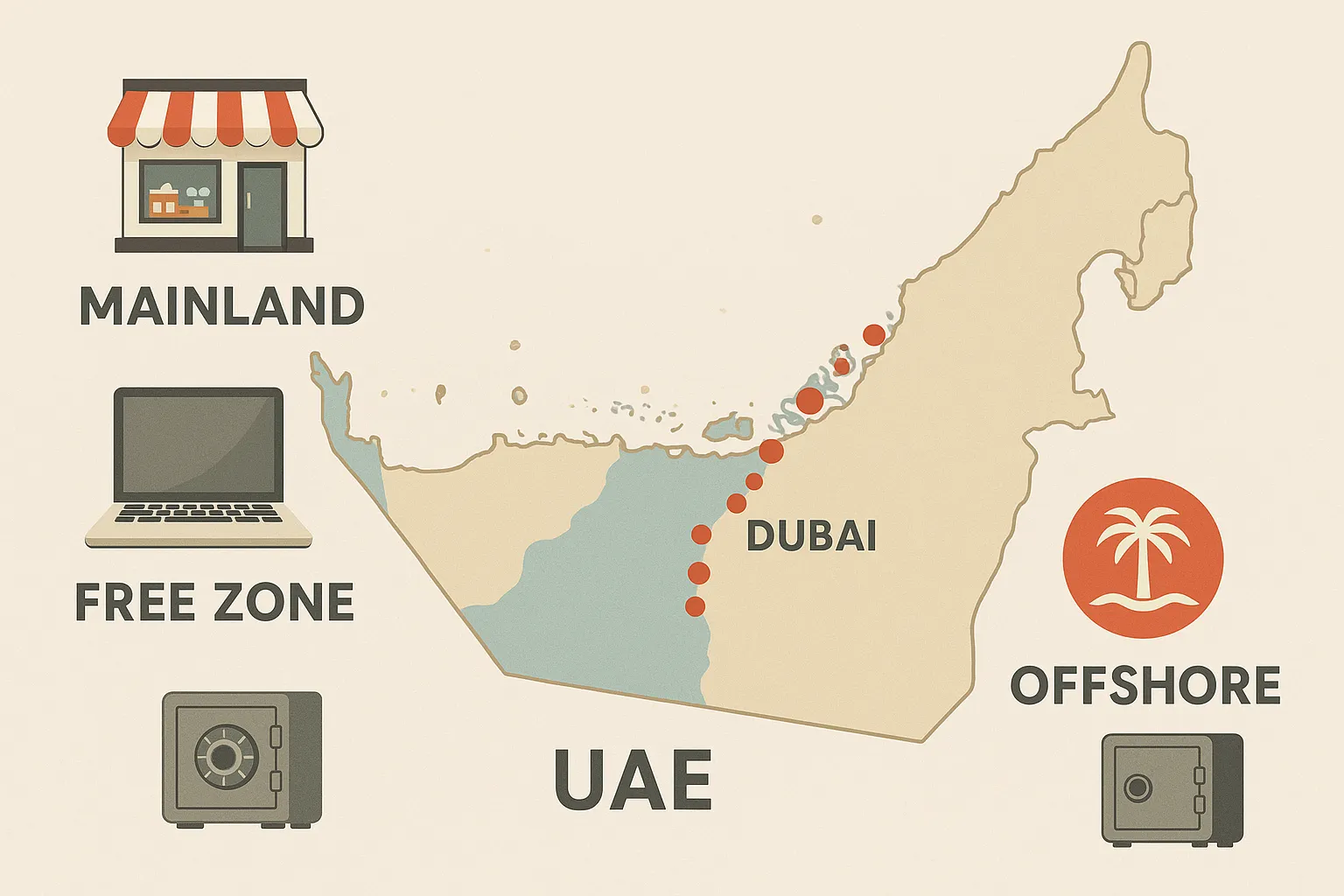
1. The Three Pillars of Company Formation in the UAE
- Mainland: A limited liability company (LLC) or sole establishment licensed by the local Department of Economy & Tourism. Can trade anywhere inside and outside the UAE, hire unlimited staff and pitch for government contracts.
- Free Zone: A ring-fenced economic area (currently 50+ in the UAE) such as DMCC or IFZA. Offers 100 % foreign ownership, simplified import/export rules and, often, sector-specific benefits (e.g. fintech sandboxes or media studios).
- Offshore: A non-resident holding vehicle created under regulations like JAFZA Offshore or RAK ICC. Cannot do business inside the UAE mainland or employ staff but is ideal for owning overseas assets or IP with minimal reporting.
2. Dubai Mainland: Full Market Access, New Tax Reality
How it works
- Licences issued directly by Dubai’s Department of Economy & Tourism (DET)
- As of 2024, 100 % foreign ownership is allowed in most activities (except strategic sectors like oil & gas)—no more compulsory Emirati majority shareholder
- Subject to the UAE’s new federal 9 % corporate tax on profits above AED 375,000 (≈ AU$155,000)
Why Australians choose it
- Retail, logistics or services that need to physically operate across the UAE
- Government or semi-government tenders that exclude free-zone entities
- Fewer restrictions on office locations and staff visas
Pain points
- Office lease required before licence issuance (even a flexi-desk counts, but costs add up in popular districts)
- Mandatory annual audits for certain activities
- VAT registration once turnover exceeds AED 375k
Typical timeline: 4-6 weeks if documents are in order.
3. Free Zone Companies: The Startup Favourite
Free zones took off after 2019 when the UAE allowed 100 % repatriation of profits and simplified e-visa portals. For Australian founders running SaaS, trading desks or consultancy work, a free-zone company is often the sweet spot.
Key upsides
- 100 % foreign ownership from day one
- Zero import/export duties inside the zone; simplified customs if you re-export
- Up to 50 year guarantees of corporate tax holidays in many zones (grandfathered despite the new 9 % rate)
- “Smart office” options from AU$4,000 per year—no need for a long commercial lease
- Fast-track immigration: Obtain two to six residence visas under one licence
Popular zones for Aussies in 2025
| Free Zone | Niche | Starting cost (AUD) | Visa quota | Stand-out perk |
|---|---|---|---|---|
| DMCC | Commodities, crypto, gold | $9,500 | 6 | Regulated crypto trading licence |
| IFZA | General trading, tech | $5,600 | 3 | One-stop digital portal, no audit for most SMEs |
| Dubai Internet City | IT & media | $12,800 | 4 | Plug-and-play offices in Media City cluster |
| RAKEZ | Manufacturing, e-commerce | $4,200 | 4 | Warehouses near port, lowest renewals |
(Note: Exchange rate used AU$1 = AED 2.45)
Caution flags
- Limited scope to trade onshore in the UAE—must appoint a locally licensed distributor or invoice from a mainland branch
- Some zones still require yearly audits regardless of turnover (DIFC, DWTC)
- Banking can be slower; a few high-street banks still prefer mainland companies for risk scoring
4. Offshore Vehicles: Tax-Efficient Holding, Zero Visa Hassle
If your goal is to hold intellectual property, buy international real estate, or raise capital through a special-purpose vehicle, an offshore entity may fit. Think of it as the Emirati equivalent of a BVI or Cayman structure—just four hours closer to Australia.
Snapshot
- Regulated under JAFZA Offshore or Ras Al Khaimah International Corporate Centre (RAK ICC)
- No minimum capital, no physical office, no employee visas
- Exempt from UAE corporate tax and VAT
- Cost: AU$2,500–3,000 all-in for first year
Typical use cases for Australians
- IP holding for a global software platform where revenues are booked elsewhere
- Real-estate ownership of Dubai freehold property without local partnership complications
- Fund-raising SPV to ring-fence liabilities before a Series A round
Offshore is not suitable if you plan to hire in Dubai, lease an office, or sell goods/services onshore.
5. Mainland vs Free Zone vs Offshore—Side-by-Side
| Criteria | Mainland LLC | Free Zone FZ-LLC | Offshore IBC |
|---|---|---|---|
| Foreign ownership | 100 % (most activities) | 100 % | 100 % |
| Onshore trading | Unlimited | Via distributor/branch | Not allowed |
| Corporate tax (2025) | 0–9 % | 0–9 % (zone-dependent) | 0 % |
| Annual audit | Sometimes | Zone-specific | No |
| Office requirement | Mandatory | Optional flexi-desk | None |
| Residency visas | Unlimited (space-based) | 2–6 typical | Not available |
| Typical setup time | 4–6 weeks | 7–10 days | 3–5 days |
| Ballpark first-year cost | AU$9k–15k | AU$4k–13k | AU$2.5k–3k |
6. Five Questions Australian Founders Should Ask Before Choosing
- Where will your revenue come from? If 80 % is earned outside the UAE, a free zone or offshore vehicle may suffice. If you need walk-in customers or UAE government contracts, mainland is safer.
- How many team members will relocate? Free zones cap visas. A fast-scaling e-commerce brand shipping from JAFZA might outgrow its quota within a year.
- Do you plan to hold Dubai property? Offshore can own freehold real estate in designated areas, often attracting less scrutiny from Australian banks when proving ultimate beneficial ownership (UBO).
- What are the ATO implications? Even with 0 % UAE tax, Australian-resident shareholders may face Controlled Foreign Company (CFC) rules. Consult a cross-border accountant early.
- Exit strategy? Some zones (e.g. DIFC) enjoy higher valuation multiples for fintech exits thanks to robust English-law courts.
7. Common Misconceptions—Busted
- “Free zone companies pay zero tax forever.” Grandfathering is real, but certain free-zone revenues will still be taxed if sourced onshore after 1 June 2025.
- “I need a local sponsor for a mainland LLC.” Not since the 2021 Commercial Companies Law overhaul—except in a handful of strategic sectors.
- “Offshore means banking is impossible.” Emirates NBD, RAKBank and mashreq all open accounts for RAK ICC and JAFZA offshore entities if KYC is clean, though minimum balances apply (≈ AU$40k).
8. Step-by-Step Timeline (Free Zone Example)
- Initial consultation & activity match (1 day) – Dubai Invest maps your Australian ABN and intended activities to the closest free-zone licence.
- Document prep & notarisation (3-5 days) – Passport copy, proof of address, and ASIC extract attested via DFAT and UAE embassy in Canberra or Sydney.
- E-application submission (24 hours) – All paperwork uploaded to the free-zone portal.
- Pre-approval & fee payment (2 days) – Security clearance plus invoice settlement.
- Licence issuance & MoA signing (same day) – Digital trade licence lands in your inbox.
- E-visa quota activation (3 days) – Entry permits generated for founders and staff.
- Bank account opening (1–3 weeks) – Dubai Invest fast-tracks meetings with preferred banks.
End-to-end: 7–10 business days for the licence; 3–4 weeks for a fully operational entity with visas and bank account.
9. How Dubai Invest Streamlines the Process
- Local PRO team on the ground: We queue at DET counters so you don’t have to endure 45 °C summer heat.
- Australian compliance check: Our partner tax advisors ensure your Constitution, shareholder loans and transfer-pricing policies match ATO guidelines.
- Banking partnerships: Pre-arranged slots with Emirates NBD and Wio Bank slash onboarding time by 40 %.
- Fixed-fee transparency: No hidden “attestation extras”. You see your all-in cost in AUD before signing.

10. The Verdict
- Choose mainland if you need unrestricted onshore trading, plan to hire at scale, or want access to government contracts.
- Choose a free zone if you run a lean, export-focused startup, value 100 % foreign ownership and lower setup fees, and can live with trading restrictions.
- Choose offshore only when you’re holding assets or IP and don’t need visas or a physical presence.
Whichever path you pick, a mismatched licence can cost more than dollars—it can burn months of momentum. Before you lodge a single form, book a free 30-minute strategy call with a Dubai Invest consultant. We’ll decode the fine print and chart the fastest, most compliant route from Australia to the Gulf.
Ready to start? Schedule your call here: https://dubaiinvest.com.au/contact