Thinking of launching in Dubai? Start with the structure
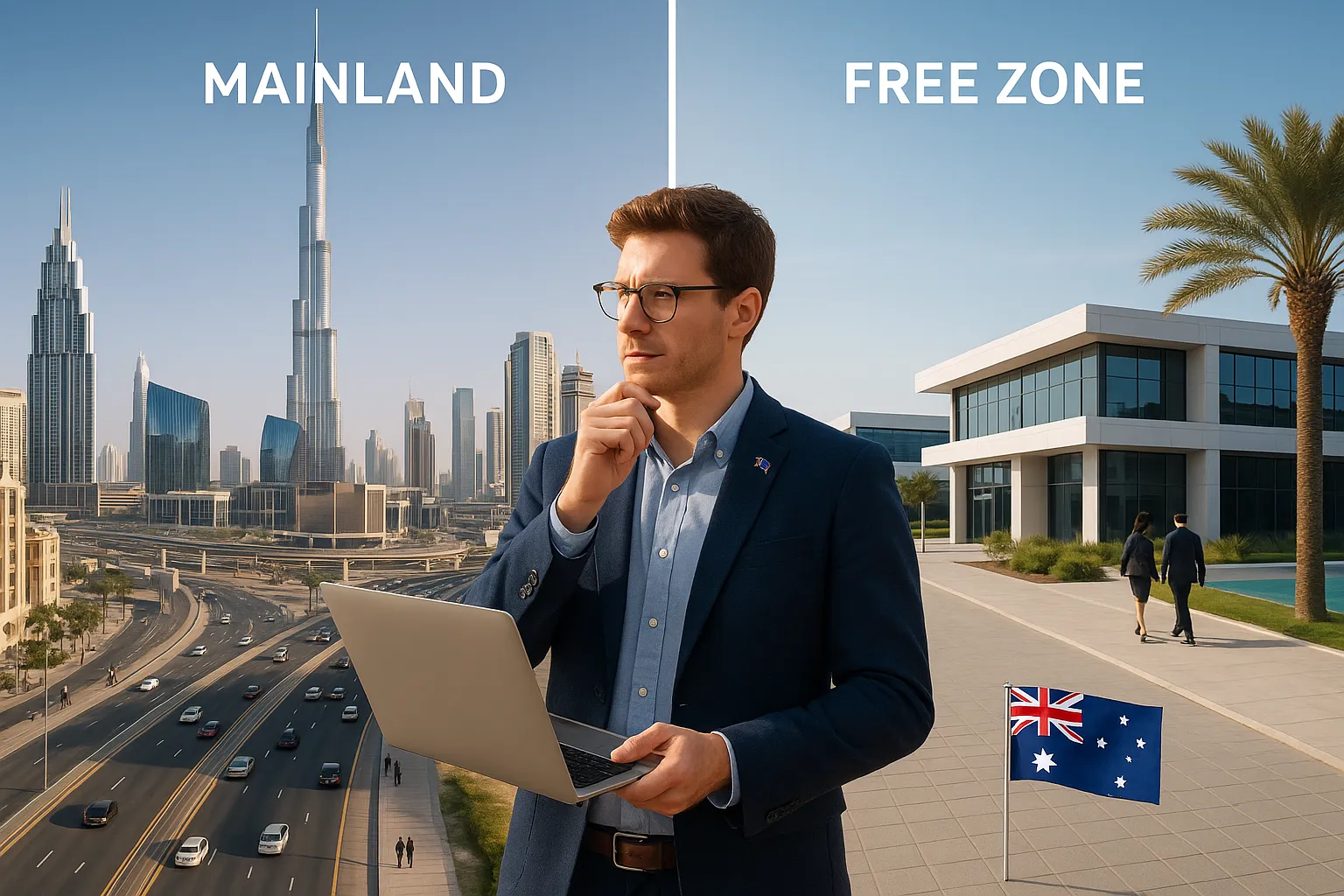
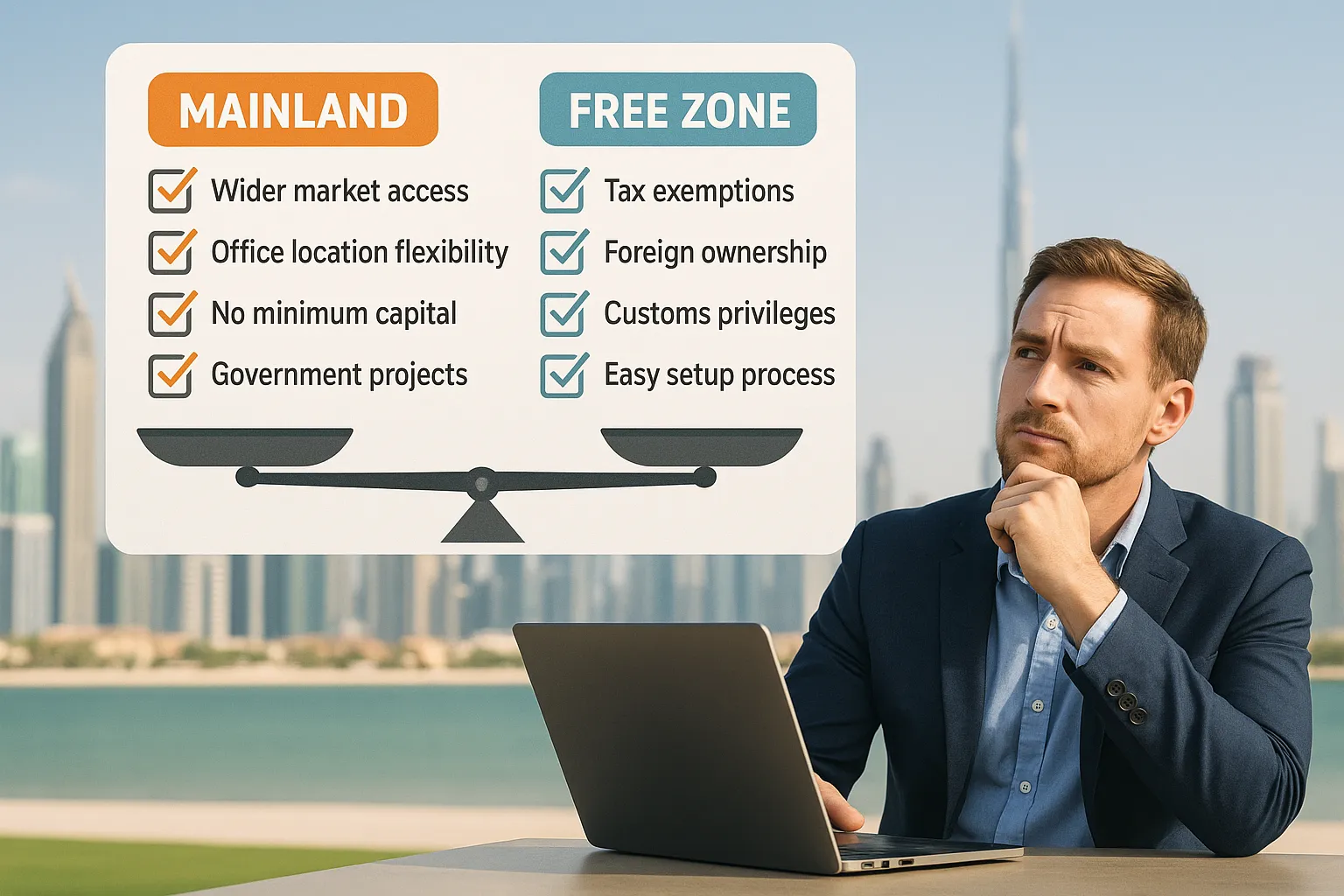
Most Australians expanding into the UAE quickly discover a fork in the road: should you register in the Mainland or inside one of the country’s many Free Zones? The decision will determine how much control you keep, who you can sell to, the taxes you pay, and even how many visas you can issue for staff.
In this guide we break down both options side-by-side, bust a few outdated myths, and offer a simple decision framework built for Aussie founders in 2025.
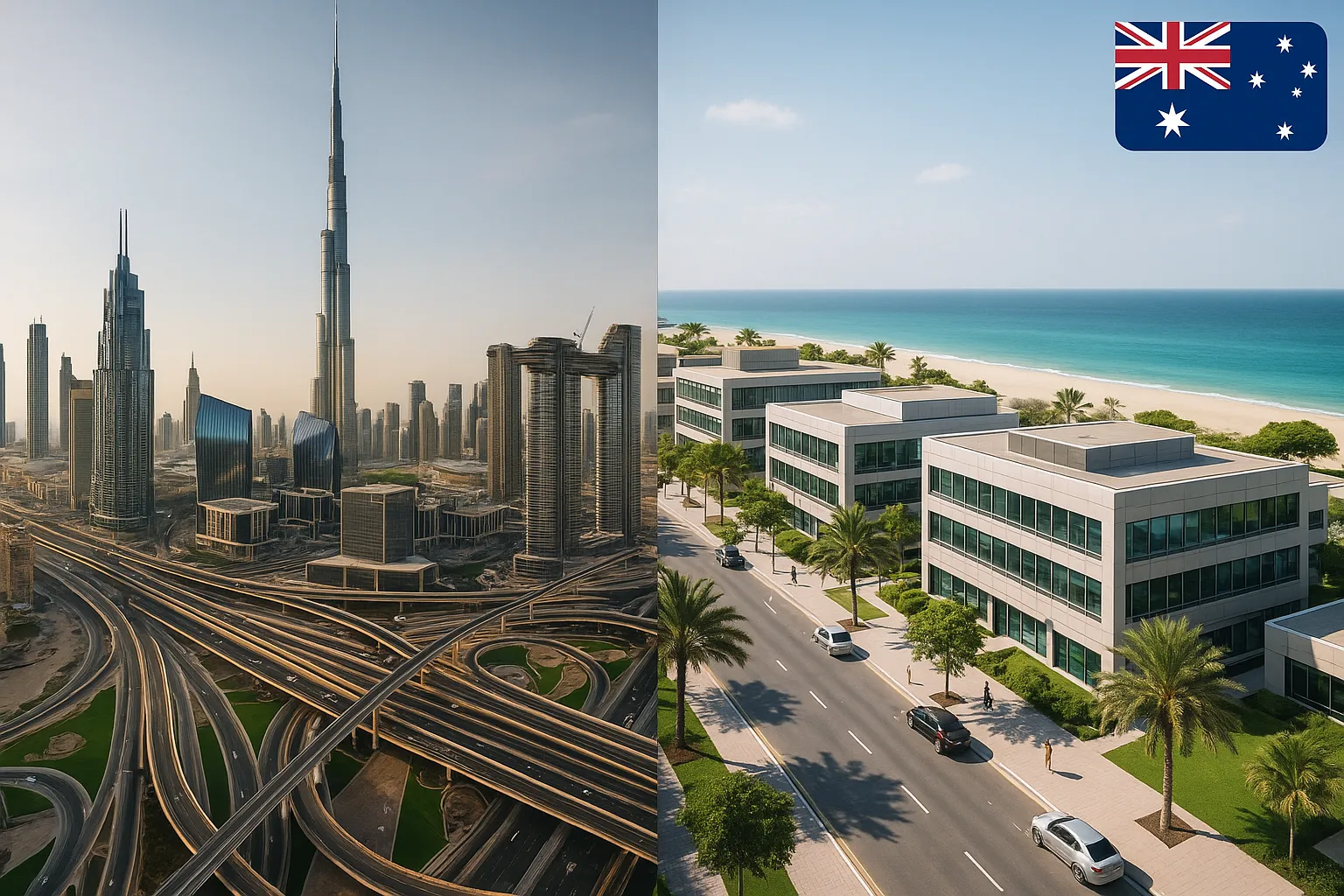
Mainland vs Free Zone at a glance
| Factor | Mainland company | Free Zone company |
|---|---|---|
| Foreign ownership | Up to 100% in most sectors since 2021 reforms (some strategic activities still need a local partner) | 100% foreign ownership by default |
| Market reach | Can trade freely across the UAE and bid for government contracts | Restricted to operating within the Free Zone or overseas; must use a local distributor to sell onshore |
| Office requirement | Physical office/warehouse mandatory; Flexi-desks permitted in some emirates for start-ups | Flexi-desk usually accepted; physical space only if activity demands |
| Corporate tax (9% from 2023) | Taxable on UAE-sourced profits above AED 375,000 | 0% on qualifying Free Zone income; 9% on mainland-sourced profits or non-qualifying income |
| Customs duties | Standard UAE customs rules | Exempt inside zone; duties apply when goods enter mainland |
| Visa quota | Linked to office size (approx. 1 visa per 9 m²) | Fixed packages (1–6 visas) upgradeable by renting more space |
| Setup timeline | 2–4 weeks | 3–10 days for most zones |
| Typical costs (first year) | AED 30k–60k incl. licence, office and visas | AED 15k–35k incl. licence, flexi-desk and visas |
Costs are indicative as at July 2025 and exclude optional trademark, bank and legal fees.
Deep dive: Mainland companies
- Ownership & legal forms
- Limited Liability Company (LLC) remains the workhorse. Since the 2021 Companies Law amendment, a UAE national sponsor is optional for most activities except strategic sectors (oil & gas, defence, etc.).
- Branches of foreign companies are also popular for Australian listed entities.
- Business activities
Anything from retail and construction to professional services. A single licence can host multiple related activities, which many Free Zones don’t allow. - Where you can trade
Anywhere in the UAE—no extra agents needed. You may also pitch for lucrative federal and emirate-level tenders. - Tax & compliance
- As of 1 June 2023, a 9% federal corporate tax applies on profits above AED 375,000.
- VAT at 5% applies if turnover exceeds AED 375,000.
- Pros
- Full access to the local market
- Unlimited visa quota (space permitting)
- Easier banking perception versus Free Zones
- Cons
- Higher upfront cost (office lease + municipality fees)
- Annual audit mandatory for most licences
- Potential need for a local partner in a handful of sectors
Deep dive: Free Zone companies
- Free Zone landscape
There are 40+ zones across the UAE, from Dubai Multi Commodities Centre (DMCC) to Ras Al Khaimah Economic Zone (RAKEZ). Each targets specific industries—media, fintech, crypto, manufacturing, healthcare, you name it. - Ownership & control
You hold 100% of the shares. No paid-up capital is required in many zones, though a bank letter may be asked. - Tax incentives
- 0% corporate tax on qualifying Free Zone income (exports, services to overseas clients).
- 9% tax kicks in only if you earn mainland-sourced revenue.
- Still 0% on dividends paid to foreign shareholders.
- Trade restrictions
Selling products or services directly to the UAE mainland requires either:- Appointing a locally licenced distributor, or
- Opening a branch/LLC later.
Violation can lead to stiff penalties.
- Visa & office flexibility
A starter “smart office” package usually includes 1–2 visas and an option to add more by renting extra space. - Pros
- Fast, low-cost setup (often under a week)
- 100% repatriation of capital and profits
- Sector-specific hubs with networking perks
- No annual audit in some zones
- Cons
- Onshore trade limitations
- Perception hurdle for certain banks and enterprise clients
- Licence renewal fees can creep up after promo year
How the 9% corporate tax really bites
A common misconception is that Free Zones automatically shield you from the UAE’s new corporate tax. The reality for 2025:
- Qualifying income: exports, transactions with other Free Zone entities, and certain passive incomes (dividends, capital gains) remain at 0%.
- Non-qualifying income: mainland sales, real-estate income (excluding commercial property in the same zone) are taxed at 9% once you cross the AED 375k profit threshold.
- Mainland companies: 9% on taxable profits above the same threshold, but you can deduct most business expenses including expat salaries.
For Australian SMEs forecasting < AED 1 million in profit for the first few years, the tax impact may be negligible. However, if you plan to scale fast—or pivot into mainland sales later—choose your structure with the long game in mind.
Australia–UAE tax treaty: your back-pocket advantage
Australia and the UAE signed an Avoidance of Double Taxation Agreement effective 1 July 2023. Key takeaways:
- Dividends, interest and royalties paid from UAE entities to Australian residents are either tax-free in the UAE or capped at 5% withholding.
- Income taxed in the UAE can be claimed as a foreign-income tax offset in Australia (check with your accountant).
- Managed properly, an onshore UAE presence can trim your combined tax bill while giving access to Middle East markets.
External source: The full text of the treaty is available on the Australian Treasury website.
Decision framework: five questions to ask
- Where are my customers?
If 80% of revenue will come from the GCC, a mainland licence avoids distributor mark-ups. Export-heavy SaaS? A tech-friendly Free Zone like Dubai Internet City might suffice. - How many employees will I hire in year one?
Mainland visa quotas scale seamlessly with office space; Free Zone packages are capped unless you upgrade. - Will I need government contracts or approvals?
Mainland entities are mandatory for certain regulated activities (healthcare, recruitment, defence). - What is my risk appetite for compliance?
Free Zones simplify reporting; mainland firms face more audits but enjoy wider market freedom. - Exit strategy?
Investors often favour Free Zone holdings for clean 100% ownership, but a mainland LLC can fetch a premium if the buyer needs onshore reach.
Cost snapshot: typical first-year budget (AUD)
| Item | Mainland LLC (Dubai) | Free Zone Package (RAKEZ) |
|---|---|---|
| Trade licence | 6,500 | 4,200 |
| Office / flexi-desk | 12,000 (15 m²) | 2,500 (smart desk) |
| Visa & medical (2 visas) | 5,000 | 3,800 |
| Bank account opener | 1,200 | 1,200 |
| Legal & attestations | 3,000 | 2,000 |
| Total | 27,700 | 13,700 |
Exchange rate AUD 1 = AED 2.45 assumed for July 2025.
Mini case studies
- Gold Coast digital agency chooses Free Zone
Lucy runs a boutique web-app studio with clients in Europe and Asia. She set up in Dubai Multi Commodities Centre (DMCC) in 2024. 100% remote work, zero onshore sales, and a 0% corporate tax rate keeps overhead low. DMCC’s crypto-friendly stance also helped her launch a side NFT project. - Perth engineering firm opts for Mainland
An EPC contractor landed a maintenance contract with a major ADNOC subsidiary. Mainland LLC status let them bid directly, hire 25 on-site engineers, and import tools without Free Zone-to-mainland customs paperwork.
Common myths—debunked
- “I need an Emirati partner to open on the mainland.”
False for most sectors since the 2021 reform. - “Free Zones are only for micro-businesses.”
Not anymore; giants like Google and Facebook operate from Dubai Internet City. - “Mainland companies always cost double.”
They’re pricier, but you can offset rent against tax and often negotiate smaller desk leases in Abu Dhabi or Sharjah.
How Dubai Invest helps Australian founders
- Tailored structure comparison reports factoring in your industry, projected revenue, and talent plan.
- Introductions to vetted local sponsors (when needed) and Free Zone authorities with Aussie-friendly banking relationships.
- End-to-end handling of licensing, visas, and corporate bank accounts—often completed before you even land in Dubai.
- Ongoing compliance support, including corporate tax registration and ESR notifications.
Ready to chart your expansion journey? Schedule a free discovery call or meet our team at the upcoming Grand Business Conference in Dubai this September—full agenda and tickets are live here: Grand Business Conference.
The bottom line: pick Mainland for unrestricted UAE trade and scale, opt for a Free Zone for cost-efficient global outreach. Either way, the earlier you map your structure to your growth plan, the fewer surprises you’ll meet on the desert highway.