Power of Attorney for Dubai Property: Setup
Buying, selling, leasing, or mortgaging a property in Dubai while you are based in Australia is absolutely possible, but the paperwork must be executed correctly. In many transactions, the document that makes remote execution practical is a Power of Attorney (POA).
A POA can be a powerful tool, and that is exactly why it needs to be set up with precision. The scope, wording, attestation pathway, and identity details must match what Dubai Land Department (DLD), developers, banks, trustees, or property managers will accept.
If you are unsure which POA you need (or whether you need one at all), a consultation can save you weeks of back-and-forth and help avoid costly mistakes. At Dubai Invest, Jomon brings on-ground work experience and business experience in Dubai, and routinely helps Australians coordinate the correct POA structure and execution sequence with the right parties.
What Is a Power of Attorney for Property in Dubai?
A Power of Attorney for Dubai property is a legal authorisation that lets you (the “principal”) appoint another person (the “attorney” or “agent”) to act on your behalf for specified property-related actions in the UAE.
In practice, a POA is used to authorise actions such as:
- Signing sale and purchase documents
- Completing DLD transfer steps
- Collecting keys and signing handover documents
- Registering or renewing Ejari (tenancy registration)
- Appointing a property manager and signing management agreements
- Signing mortgage-related paperwork (where permitted by the lender)
A POA does not automatically give ownership of your asset to someone else. It only grants authority to act within the POA’s defined scope.
For reference on official property procedures and transfer requirements, you can cross-check guidance through the Dubai Land Department.
Why You Need a Power of Attorney for Dubai Property Transactions
Most Australian buyers look at a POA for one core reason: they want the deal to progress without needing multiple in-person trips to Dubai.
A correctly drafted and properly attested POA can help you:
- Keep momentum on time-sensitive opportunities (off-plan allocations, resale negotiations, settlement windows)
- Reduce travel friction when documents require wet signatures or in-person presentation
- Keep the transaction moving if a bank, trustee office, or developer requires physical attendance
- Manage post-settlement operations remotely (leasing, renewals, maintenance approvals)
A POA is often most valuable at “choke points” where a process stalls without a local representative. For Australians investing remotely, those choke points typically appear around identity verification, notarisation, DLD/trustee steps, and handover or leasing setup.
If you want the broader purchase workflow, see: What is the step-by-step process for buying property in Dubai?
Types of Power of Attorney Used in Dubai Real Estate
Not all POAs are treated the same. The right type depends on the action you need performed.
| POA type | What it typically authorises | When Australians commonly use it |
|---|---|---|
| General POA | Broad authority across many personal and financial matters | Rarely recommended for property deals due to risk and over-breadth |
| Special POA (Property-specific) | Specific authority for a defined property and defined actions | Buying, selling, transferring, signing SPA/MOU, DLD transfer steps |
| Property management / leasing POA | Leasing, renewals, Ejari, maintenance approvals, dealing with building management | Remote landlord management, tenant changes, operational tasks |
| Mortgage-related POA | Limited bank/lender-related actions (varies by lender) | When a non-resident buyer cannot attend certain mortgage steps |
Most investors should prefer a Special POA drafted specifically for the transaction, with clear limits and a defined purpose.
Who Can Grant and Receive Power of Attorney in Dubai?
Eligibility and acceptance can depend on the authority you are dealing with (notary, DLD trustee, developer, bank), but generally:
- The principal must be an adult with legal capacity to grant authority.
- The attorney is usually an adult individual who can be identified and verified.
- Names, passport details, and (where relevant) Emirates ID details must match exactly across the POA and transaction file.
In real estate transactions, the attorney is often:
- A trusted family member or business partner in the UAE
- A representative coordinating the transaction locally
- In some cases, a lawyer (subject to legal engagement terms)
Because POA authority can be abused if drafted too broadly, the “who” is not just a legal question, it is a risk management question. This is a key reason Australians benefit from a consultation before signing anything.
Step-by-Step Process to Set Up a Power of Attorney in Dubai
The steps depend on whether you sign inside the UAE or overseas (for example, in Australia), and on whether the receiving party requires a UAE-notarised document.
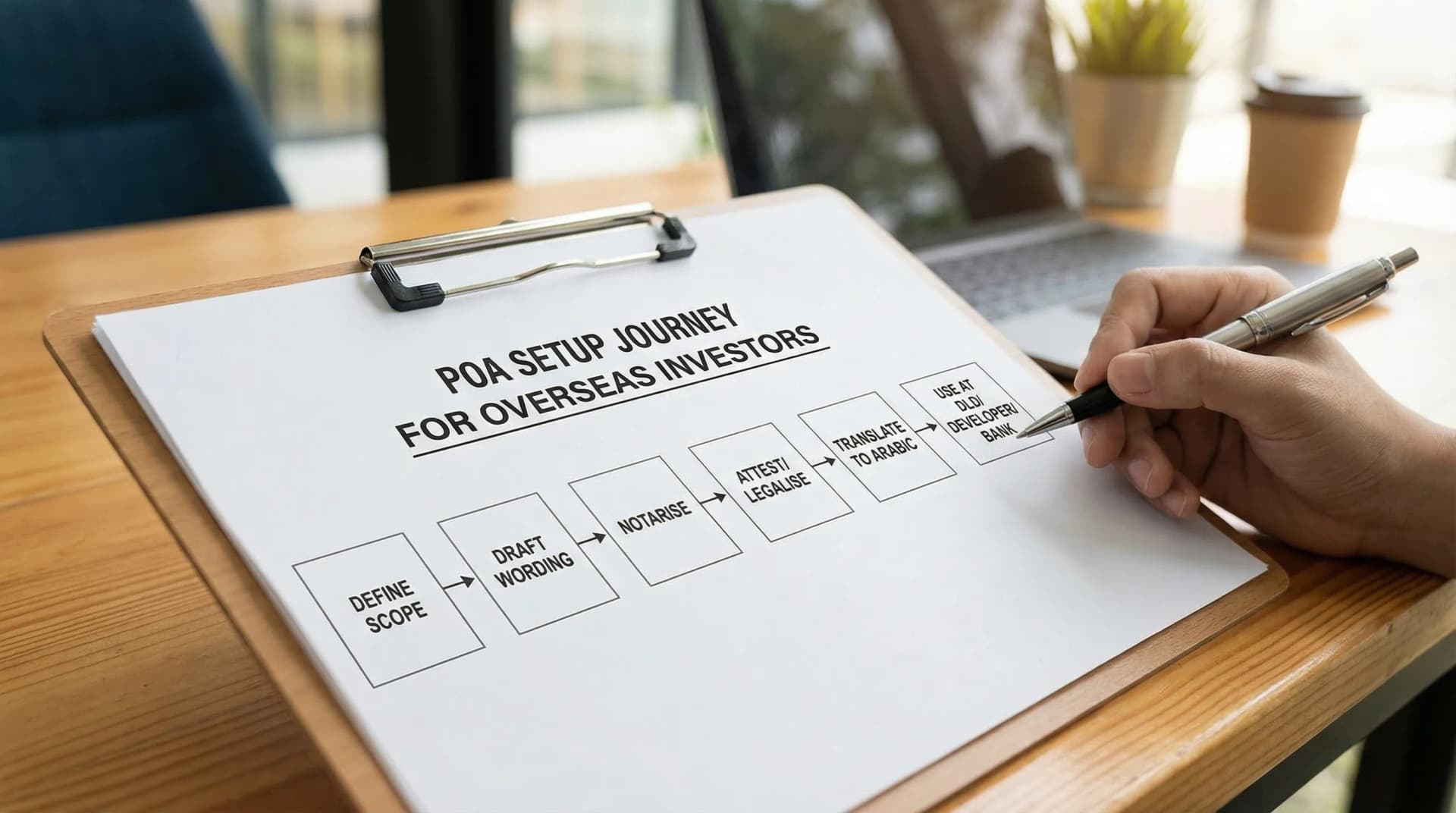
A practical, investor-friendly workflow usually looks like this:
- Define the exact purpose: purchase, sale, handover, leasing, property management, mortgage steps, or a combination.
- Choose the right attorney and decide whether authority should be limited by time, transaction stage, or specific property.
- Draft the POA wording to match what the DLD trustee office, developer, or bank expects (scope is everything).
- Notarise the POA in the correct jurisdiction (Dubai notary or overseas notary).
- Attest and legalise the POA (UAE process and/or overseas process, depending on where it was executed).
- Translate to Arabic if required for acceptance (commonly required for use in the UAE).
- Use the POA for the transaction step (DLD transfer, handover, Ejari, bank steps), keeping copies and proof of submission.
If your goal is remote execution end-to-end, it also helps to plan your POA alongside your broader closing sequence, including FX timing and settlement logistics. Related guide: How to send a Dubai property deposit safely
Documents Required for Property Power of Attorney in Dubai
Document requirements vary depending on where you sign and who will rely on the POA. That said, Australians most commonly need a set like the below.
| Category | Commonly requested items | Notes |
|---|---|---|
| Principal ID | Passport copy | Ensure consistency with the passport used in the property transaction |
| Attorney ID | Passport copy (and Emirates ID if applicable) | Exact spelling must match the POA |
| Property details (if Special POA) | Property identifier details where available | The more specific the POA, the safer it generally is |
| Supporting evidence | Proof of address and contact details (sometimes requested) | Often part of a broader KYC file |
| Draft POA text | Final wording approved for the intended use | The critical part is scope and correct authority clauses |
Because “required documents” can change based on whether you are dealing with a developer, a DLD trustee office, or a lender, investors often lose time by preparing the wrong pack. A consultation helps you align the POA pack with the exact transaction pathway.
How to Attest a Power of Attorney (UAE & Overseas Process)
Attestation is where many remote buyers get stuck, because there is no single one-size-fits-all route. The correct approach depends on:
- Where the POA is executed (Dubai vs Australia)
- Which entity will rely on it (DLD/trustee, developer, bank, building management, property manager)
- Whether Arabic translation and UAE Ministry of Foreign Affairs and International Cooperation (MOFAIC) steps are required
If the POA is signed in the UAE
Typically, a POA used for property transactions is prepared and notarised through the relevant UAE notary pathway, then used directly with the parties involved.
If the POA is signed in Australia (overseas)
Overseas POAs often require a legalisation chain before they are accepted in the UAE. Depending on the document and the authority relying on it, the steps may include:
- Notarisation in Australia
- Legalisation (for example, apostille or consular legalisation depending on current rules and document type)
- UAE-related attestation steps
- Arabic legal translation (commonly required for UAE usage)
Because rules and acceptance standards can change, treat any generic checklist as a starting point only. For government-facing steps, confirm requirements with the competent authority. MOFAIC information is available via the UAE Ministry website: MOFAIC.
Can Expats Use Power of Attorney for Property in Dubai?
Yes, expats commonly use POA for Dubai property, including:
- Non-resident investors purchasing from overseas
- UAE residents travelling frequently who want continuity for leasing and renewals
- Owners holding multiple properties who want a manager or trusted representative to execute operational tasks
For Australians specifically, POA is frequently part of a “remote investor stack” alongside due diligence, conveyancing coordination, and a clean funds-transfer trail.
If you are managing rentals from Australia, you may also want: Remote Landlord 101: Managing Dubai rentals from Sydney
Validity and Renewal of Power of Attorney in Dubai
Whether a POA expires depends on how it is drafted and what the relying authority accepts.
Common validity approaches include:
- Transaction-limited POA: valid for a specific transaction or milestone (often the safest option).
- Time-limited POA: valid until a stated expiry date.
- Open-ended POA: no explicit expiry, which may increase risk and may not be ideal for remote investors.
Renewal usually involves re-executing and re-attesting a fresh POA if the old one expires or no longer matches the required scope.
If your plan includes both purchase and post-settlement leasing, you might need two separate POAs, or one POA carefully drafted to cover both phases without becoming overly broad.
Risks and Limitations of Property Power of Attorney
A POA reduces friction, but increases operational risk if not controlled.
Key risks include:
- Over-broad authority: a general POA can unintentionally authorise actions you never intended.
- Identity mismatches: spelling differences across passports, contracts, and POA documents can cause rejection.
- Misuse by the attorney: the attorney can act within the POA’s scope even if you later disagree.
- Bank limitations: some lenders require personal attendance for certain steps, even with a POA.
- Acceptance variability: developers, trustee offices, and banks may have different POA wording expectations.
A practical way to reduce risk is to design the POA like you would a finance mandate, minimum scope, clear limits, and defined end point.
How to Cancel or Revoke a Power of Attorney in Dubai
Revocation is a legal step, not just an email instruction.
In general terms, cancellation involves:
- Preparing a formal revocation document through the appropriate notary pathway
- Notifying the attorney that the POA is revoked
- Notifying any third parties who were relying on the POA (for example, property manager, developer, bank, or other counterparties)
If the POA was used in multiple places, you want a controlled “notification map” so the old POA does not keep circulating.
Because the mechanics can vary by where the POA was executed and where it is recorded, this is another moment where a consult prevents loose ends.
Common Mistakes to Avoid When Setting Up POA
Most POA failures in Dubai property transactions are avoidable, but they usually happen because investors treat a POA as a generic template.
Common mistakes we see with Australian buyers include:
- Drafting a POA that is too broad (creating unnecessary risk)
- Drafting a POA that is too narrow (it gets rejected because it does not cover the required step)
- Using inconsistent names, passport numbers, or signatures across documents
- Missing key property identifiers in a Special POA
- Underestimating attestation time and sequencing (especially when a settlement window is tight)
- Assuming a POA that worked for leasing will work for sale, transfer, or mortgage steps
If you want to avoid trial-and-error, book a consult and have the POA mapped to your exact transaction workflow before you sign.
Power of Attorney vs Property Ownership Rights in Dubai
This distinction matters for investor protection.
- Property ownership in Dubai is evidenced through the relevant title documentation and DLD registration processes.
- A Power of Attorney is simply an authority instrument, it authorises someone to act, but it does not transfer ownership by itself.
A POA can be used to sign documents that lead to a transfer, but the transfer itself is governed by the formal DLD process and associated documentation.
If you are still getting comfortable with DLD procedures and what gets issued when, see: Dubai Land Department explained: procedures, fees and timelines for foreign buyers
Book a Consultation to Set Up the Right POA (and Avoid Rejections)
A POA can either make your Dubai property transaction smooth, or become the document that delays your settlement.
If you are investing from Australia and want to set up the correct Power of Attorney for Dubai property, book a consultation with Dubai Invest. Jomon’s on-ground Dubai work experience and business experience helps Australians structure the POA around the real transaction sequence, coordinate attestation requirements, and reduce the risk of rejected documents or overly broad authority.
Get started here: Dubai Invest consultations