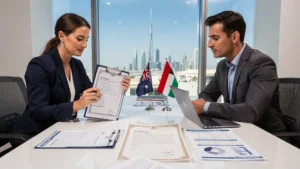
Buying off-plan in Dubai can be a smart way for Australians to enter the market with staged payments and strong choice of stock, but it also concentrates risk in one place: the developer. Before you pay a booking fee or sign a Sales and Purchase Agreement (SPA), you need a repeatable way to verify a Dubai developer using official checks, evidence of delivery, and contract scrutiny.
This 2026 guide gives you a practical due-diligence workflow you can follow from Australia, plus the exact areas where a local, on-ground consultation can save you from costly assumptions.
Why Developer Verification Matters for Off-Plan Property
In an off-plan purchase, you are not buying a finished asset, you are buying a promise backed by approvals, escrow protections, and the developer’s capacity to deliver. Even in a regulated market like Dubai, the outcome for buyers varies widely between developers, projects, and master communities.
Developer verification matters because it helps you:
- Reduce the risk of delays and specification changes that impact cash flow and resale timing.
- Confirm the project is properly registered and the buyer funds are routed through the right channels.
- Avoid marketing hype that is not supported by approvals, budgets, and documented delivery history.
- Understand the true contract terms (handover date logic, penalty clauses, variation rights, and assignment rules).
For Australian buyers, this is even more important because purchases are often done remotely, with documents signed across time zones and funds sent internationally. A structured pre-check is the easiest way to protect yourself before you commit.
Check Developer Registration and Approvals
Start with the non-negotiables: official registration and project approvals. Dubai’s off-plan system relies on registration and escrow processes that are designed to protect buyers, but you still need to confirm they exist for the specific project you are buying.
Key checks to run:
- Developer registration: Confirm the developer is registered with the Dubai Land Department (DLD) and is authorised to sell off-plan.
- Project registration: Verify the specific project is registered (not just the master developer or marketing name).
- Escrow account: Confirm an escrow account is in place for that project, and understand how your payments will be handled.
- Sales channel legitimacy: Ensure the person or company selling you the unit is properly licensed and has a valid mandate to sell.
A useful starting point is the official Dubai Land Department (DLD) ecosystem and related buyer tools (including DLD’s Dubai REST platform). If you are unsure what to look for, get guidance before transferring funds because “we’ll send the escrow later” is a classic avoidable risk.
| Approval item | What you should confirm | Why it matters | Typical red flag |
|---|---|---|---|
| Developer registration | Entity is properly registered with the relevant authorities | Confirms legal standing to sell | Sales entity name does not match developer entity |
| Project registration | The exact project is registered (not a similar name) | Prevents bait-and-switch | Only brochures, no registration evidence |
| Escrow structure | Project-level escrow account exists and is used | Helps protect buyer funds | Asked to pay to a general corporate account |
| Authorised sales | Agent/broker is properly licensed | Reduces misrepresentation risk | Pressure to pay “today” with minimal paperwork |
Evaluate the Developer’s Track Record
Once the project is confirmed as properly registered, shift to the developer’s execution record. In Dubai, delivery history is one of the best predictors of how a developer handles construction quality, timelines, defects, and post-handover support.
What to evaluate (and how):
- Delivered projects vs launched projects: Ask for a list of completed projects, then cross-check that they are actually delivered and occupied.
- Handover timeliness: Delays happen in every market, but patterns matter. Look for repeated, multi-year delays across projects.
- Build quality indicators: When possible, inspect finished buildings by the same developer, not just the display suite. If you are remote, request independent photo and video evidence.
- After-sales and defect handling: Ask owners and tenants (not just sales staff) about snagging response times and warranty follow-through.
- Service charge outcomes: A great purchase price can be undermined by high running costs. Track record includes how buildings perform after handover.
Practical tip for Aussies: if you are comparing two similar off-plan deals, the one backed by a stronger delivery record is often the better “sleep at night” investment, even if the headline discount looks smaller.
This is also where it helps to work with someone who has operated on the ground. Dubai Invest’s principal consultant, Jomon, brings real job and business experience in Dubai, which makes it easier to sanity-check what the marketing says against how projects and communities work in practice.
Financial Health and Transparency
A developer can be registered and still be financially stretched. Your goal is not to become an auditor, it is to identify warning signs that suggest the project could stall, specs could be downgraded, or handover could be pushed out.
What “good” transparency looks like:
- Clear payment milestone schedule tied to construction stages.
- Escrow-first payment routing with matching documentation.
- Straight answers on construction status and procurement.
- Consistency across brochures, SPA schedules, and official project details.
Risk signals to watch:
- Unusual payment requests: Large “administration” fees, payments to unrelated entities, or shifting bank details.
- Aggressive incentives: Overly generous guarantees with vague terms, especially if not written into the SPA.
- Timeline vagueness: Handover date language that gives the developer broad flexibility with limited buyer remedies.
If you are doing a short Dubai trip to validate multiple projects in a tight window, plan it like a work sprint. Many investors underestimate how exhausting back-to-back site inspections can be.
Legal and Contractual Considerations
In off-plan purchases, the SPA is where risk is either managed or multiplied. Even if you trust the developer, you still need to understand what you are signing.
Focus areas to review (ideally with independent legal support):
- Unit details and plans: Exact unit number, size methodology, parking allocation, view description, and finishing specs.
- Variation rights: The contract often allows changes, but the limits matter (and what compensation applies).
- Handover date mechanics: Look for how handover is defined, what counts as force majeure, and what remedies exist if delays occur.
- Defects liability and warranties: Duration, process, and what is excluded.
- Assignment and resale rules: Whether you can sell prior to completion, any developer fees, and minimum paid percentage requirements.
- Dispute resolution: Jurisdiction, venue, and process.
For Australians, documentation also intersects with practical execution: Power of Attorney format, notarisation, attestation, and timing of money transfers. A contract that is fine “in theory” can still be hard to execute remotely if the process is not mapped end-to-end.
How DubaiInvest Helps Australians Verify Developers
A lot of buyers only ask for help after they have paid a deposit. The best time to engage support is before you commit, when you still have leverage to walk away or renegotiate.
Dubai Invest supports Australians to verify a Dubai developer and the specific project by coordinating the full diligence workflow, including:
- Sanity-checking the developer and project positioning (what is real, what is marketing, what is missing).
- Helping you gather and interpret registration and project documentation.
- Coordinating legal and documentation handling for remote buyers.
- Stress-testing the deal structure: payment plan, FX timing, and cash-flow implications.
- Providing an on-ground perspective informed by Jomon’s work and business experience in Dubai.
If you want the diligence done efficiently, book a consultation before signing so the verification happens in the right order and you do not waste time chasing the wrong documents.
Key Takeaways for Australian Investors
Developer checks are not about paranoia, they are about process. If you treat verification as a checklist, you reduce emotional decision-making and improve your odds of a smooth handover.
Here are the core takeaways:
- Always confirm developer and project registration, not just the brand name on the brochure.
- Validate escrow and payment routing before sending funds.
- Track record beats promises, look at delivered buildings and owner outcomes.
- Read the SPA for handover mechanics, variation rights, snagging and resale rules.
- If you are buying remotely, map the execution steps (signing, attestations, FX, and deadlines) early.