
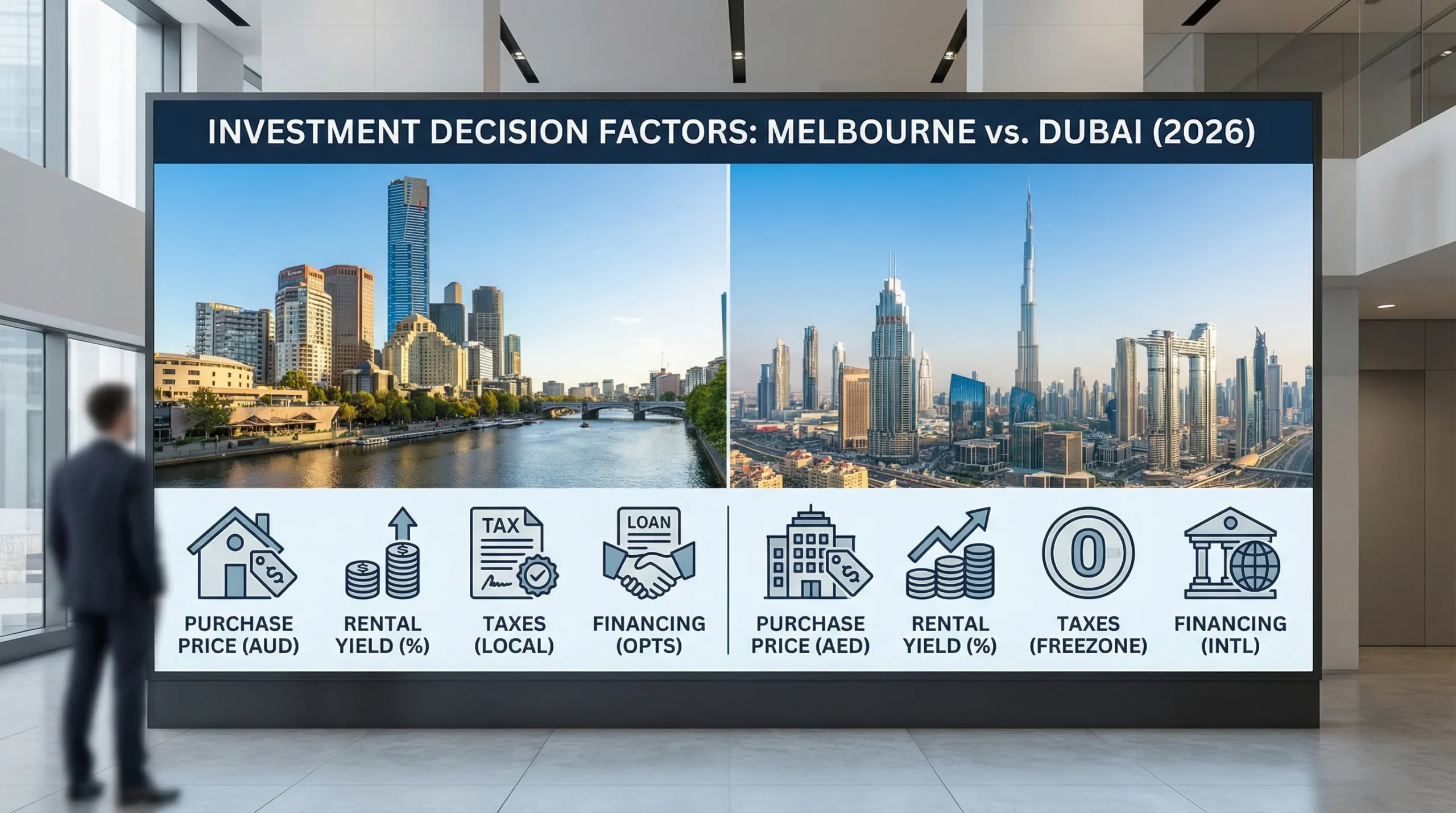
Melbourne vs Dubai Real Estate 2026: Where Should You Park Your Capital?
If you’re sitting in Melbourne and wondering whether your next real estate investment should stay local or head offshore, 2026 is a genuine fork-in-the-road year. Melbourne still offers familiarity, deep lending markets, and a mature legal framework. Dubai, meanwhile, continues to pull global capital with investor-friendly ownership zones, strong rental performance in many communities, and a tax profile that can improve after-cost returns (depending on your ATO position).
This comparison is written for Australians making a capital-allocation decision, not for headline browsing. Numbers vary by suburb, building, and loan profile, so treat the figures below as directional and confirm deal-level assumptions in a consultation. Dubai Invest’s lead consultant Jomon Ulahannan has lived and worked in Dubai, with hands-on business and property experience on the ground. That local context matters when you’re buying remotely.
Economic Outlook 2026: Australia vs UAE
GDP Growth Comparison
Australia’s growth story in 2026 is largely tied to productivity, migration, and services, with housing affordability and construction capacity as ongoing constraints. The UAE’s growth profile is more diversified than it was a decade ago, with logistics, tourism, financial services, and tech playing a larger role, plus continued state-led infrastructure investment.
For property investors, the practical takeaway is this: Australia tends to behave like a lower-volatility, lower-beta market, while Dubai can move faster in both directions, with cycle timing and micro-location selection carrying more weight.
Population Growth & Migration Trends
Melbourne’s demand base is heavily influenced by overseas migration, student arrivals, and intra-Australia relocation. Dubai’s demand base is shaped by global migration flows, regional business expansion, and residency reforms that encourage longer-term stays.
In both cities, population growth supports rentals, but the tenant profile differs:
- Melbourne demand is often anchored by local wages and household formation.
- Dubai demand is strongly linked to expat employment, business formation, and international mobility.
Currency Strength: AUD vs AED
This is one of the most overlooked variables for Australians.
- The AUD floats and can swing meaningfully with commodity cycles and global risk sentiment.
- The AED is pegged to the USD, so when you buy Dubai property you are effectively taking USD-linked currency exposure.
That can cut both ways. A good investment can look average if FX moves against you, and an average investment can look great with favourable FX. It is worth modelling the scenario where the AUD strengthens or weakens materially over your intended hold period.
Interest Rate Environment
In 2026, Australia’s interest-rate settings still flow directly into mortgage pricing and borrowing capacity, especially for investors.
In the UAE, mortgage pricing is influenced by USD-linked rates and bank-specific risk appetite for non-residents. For Australians, access is real, but underwriting and documentation standards are different, and timelines can surprise first-time buyers.
Property Prices in 2026: Melbourne vs Dubai
Median Apartment Prices
Apartment pricing in Melbourne varies widely by distance to the CBD, building quality, and owner-occupier appeal. In Dubai, apartments can span from high-turnover investor stock to prime branded residences with very different performance characteristics.
Rather than fixating on a single median, investors are better served by comparing the price of a “rent-ready, financeable, liquid” apartment in each market.
Median House Prices
Melbourne houses are often land-value driven, and scarcity in established suburbs can support long-term capital preservation.
Dubai “house” exposure usually means villas or townhouses in master communities. Supply dynamics are different because Dubai can add new communities quickly, so capital growth is more sensitive to community popularity, infrastructure delivery, and competing new launches.
Off-Plan vs Established Property Costs
Both markets offer new-build versus established options, but the mechanics differ:
- Melbourne off-the-plan purchases can face valuation risk at settlement and stricter lending outcomes.
- Dubai off-plan purchases typically involve staged payment plans, escrow protections, and developer reputation becomes a critical risk variable.
If you plan to invest in Dubai off-plan, it is worth doing developer due diligence, escrow verification, and exit planning before you pay a deposit.
Entry-Level Investment Budget Comparison
Below is a practical, investor-focused budget comparison (directional ranges as of early 2026). Exact outcomes depend on suburb/community, building quality, and FX on the day you convert funds.
| Cost item (investment-grade) | Melbourne (AUD) | Dubai (AED) | What usually drives the range |
|---|---|---|---|
| Apartment purchase (typical investor stock) | $550k to $900k | AED 700k to AED 1.6m | Location, building quality, scarcity, and end-user demand |
| House or villa-style exposure | $900k to $1.6m+ | AED 1.8m to AED 4.5m+ | Land component (Melb) vs master community supply (Dubai) |
| One-off transfer costs | Higher and state-based | DLD fee is typically a fixed % of price | Stamp duty vs DLD fee and admin costs |
| Typical “all-in” cash to get started | Often higher due to stamp duty and buffers | Often lower purchase price per bedroom in many areas | Depends on leverage, fees, and furnishing strategy |
Want this table tailored to your exact budget and target yield? That is the point where a consultation saves real money, because the “best suburb” answer changes with your tax rate, loan type, FX timing, and exit plan.
Rental Yields: Which Market Pays You More?
Average Rental Yield in Melbourne (2026)
For many Melbourne investors, gross yields commonly sit in a moderate band, often stronger in apartments than houses, and stronger in outer or growth corridors than blue-chip inner suburbs. Net yield is then reduced by property management, maintenance, insurance, and (often) land tax depending on your structure.
Average Rental Yield in Dubai (2026)
Dubai is frequently discussed because gross yields in many freehold communities can be meaningfully higher than typical Australian capital-city yields, especially in mid-market and high-demand rental clusters. Dubai Invest commonly sees Australians target a yield-first strategy in areas where tenant demand is resilient and service charges are not excessive.
This is where the “Dubai rental yield vs Melbourne” conversation gets real. Many Australians look at Dubai because it can improve cash flow on a like-for-like capital outlay, but only if you underwrite net yield properly.
Short-Term vs Long-Term Rental Returns
Melbourne short-term letting is heavily dependent on local rules, strata by-laws, and occupancy seasonality, making the short-term vs long-term decision highly location-specific.
Dubai short-term letting can be lucrative in the right buildings and locations, but it brings licensing, furnishing, operator fees, and higher wear-and-tear. In some cases, long-term leasing produces a cleaner, more predictable net result.
Gross vs Net Yield Differences
Headline yields are not your yield.
In both markets, net yield depends on costs that are easy to underestimate:
- Ongoing levies (strata in Melbourne, service charges in Dubai)
- Vacancy and leasing costs
- Repairs, refresh, and compliance
- Management fees (especially for holiday lets)
A consultation helps because net-yield modelling is deal-specific. Two similar-looking apartments can deliver very different net outcomes once you account for service charges or strata, and tenant quality.
Tax Comparison: Australia vs Dubai Property Taxes
Capital Gains Tax (CGT)
Australia has CGT rules that generally apply to Australian tax residents on worldwide assets, with the CGT discount potentially available when conditions are met.
Dubai generally does not levy capital gains tax on residential property for individuals, but Australians may still have ATO reporting depending on residency and structure.
Stamp Duty / DLD Fees
Melbourne buyers typically face stamp duty (and potentially surcharges depending on circumstances and rules at the time).
Dubai buyers typically face Dubai Land Department (DLD) transfer fees, which are commonly calculated as a percentage of the purchase price, plus admin charges.
Ongoing Property Taxes
In Australia, land tax can be a material annual cost for investors depending on land value thresholds, holdings, and ownership structure.
Dubai does not have an annual property tax in the way Australians think about land tax, but you do have ongoing building service charges and other holding costs that must be modelled.
Income Tax on Rental Income
Dubai does not levy personal income tax on most residential rental income for individuals, but Australians should not assume “tax-free”. If you remain an Australian tax resident, rental income is typically reportable in Australia.
Foreign Ownership Rules
In Dubai, foreign ownership is permitted in designated freehold areas, and transactions are supported by a well-developed transfer and title system.
In Australia, foreign buyers face FIRB rules and restrictions. While this is less relevant if you are an Australian citizen or permanent resident buying in Melbourne, it matters for mixed-status families, expats returning, or overseas structures.
Because cross-border tax outcomes can change with residency, structure, and treaty settings, this is exactly where getting advice early is cheaper than fixing mistakes later.
Financing & Mortgage Rules
Mortgage Rates in Australia (2026)
Australian investor mortgage pricing varies by lender, LVR, and whether you choose fixed or variable. What matters more than the headline rate is serviceability, buffers, and how your existing debts cap borrowing capacity.
Mortgage Rates in UAE (2026)
UAE rates for non-residents vary by bank, property type (ready vs off-plan), and profile strength. Australians often find the process document-heavy, and timing-sensitive when you are trying to meet developer or trustee deadlines.
LVR for Expats & Foreign Buyers
As a rule of thumb, non-resident buyers in the UAE often see lower LVRs than local residents. Dubai Invest regularly assists Australians who want clarity on realistic leverage before they commit to a purchase.
Deposit Requirements
Deposit expectations differ by market:
- In Melbourne, lender rules and LMI thresholds shape how far your deposit goes.
- In Dubai, non-resident mortgages commonly require a larger deposit, plus you need to budget for DLD fees and other closing costs.
If you want a clean “borrowing-ready” plan, book a consultation and ask for an end-to-end funding pathway (loan plus FX transfer plan plus settlement timeline).
Capital Growth Potential: 5-Year Outlook
Melbourne Growth Drivers
Melbourne’s long-term drivers typically include population growth, constrained established-land supply, and infrastructure expansion. The trade-off is that high entry prices and holding costs can compress cash flow.
Dubai Growth Drivers (Expo legacy, population inflow, visa reforms)
Dubai’s growth drivers in 2026 still include the Expo legacy and the expansion of new economic districts, plus ongoing population inflow and residency reforms that can increase longer-term demand.
For Australians, the biggest advantage is the ability to target specific demand nodes (job hubs, transport, lifestyle corridors) and buy in freehold communities where foreign ownership is clear.
Historical Growth Comparison (2015–2025)
Both markets have been cyclical.
- Melbourne has historically shown strong multi-year growth phases, with periods of rate-driven cooling.
- Dubai has historically shown sharper cycles, with faster rebounds when demand and liquidity return.
The right comparison is not “which always goes up”, it is “which suits my risk tolerance and time horizon.”
Risk Factors in Both Markets
Key risks to underwrite:
- Melbourne: interest rate sensitivity, holding costs, and policy changes.
- Dubai: micro-market selection, service charge creep, off-plan execution risk, and FX exposure.
A serious real estate investment plan is a risk plan first.
Legal & Ownership Structures
Freehold vs Leasehold in Dubai
Dubai freehold ownership gives you title ownership in designated areas, which is typically what Australian investors want for long-term holds and resale liquidity. Leasehold exists too and can be appropriate in limited situations, but it changes your financing and exit logic.
FIRB Rules in Australia
If FIRB applies to you (for example, non-resident status or certain structures), it can affect what you can buy, how long approvals take, and total costs.
Buying Through Company or Personal Name
Ownership structure impacts lending, taxes, and succession planning. Some Australians buy personally for simplicity, others use company structures for risk and planning reasons.
If you are also considering business setup in Dubai, structure can become even more important because company ownership, banking, and compliance all intersect.
Residency & Visa Implications
Dubai property can sometimes support residency pathways depending on value thresholds and rules at the time. That is not a reason to buy a bad asset, but it can be part of your broader plan.
Lifestyle & Exit Strategy Considerations
Living in Melbourne vs Dubai
Melbourne offers familiarity, established community networks, and predictable consumer protections.
Dubai offers global connectivity, lifestyle infrastructure, and an environment that many Australian expats and business owners find compelling. Whether it fits you depends on climate preference, schooling, work setup, and family goals.
Liquidity & Resale Speed
Liquidity is asset-specific.
- In Melbourne, liquidity can be strong in owner-occupier suburbs and well-located houses.
- In Dubai, liquidity can be strong in recognised communities and buildings with proven rental demand and transparent service charges.
Currency Risk
If you invest in Dubai, you must acknowledge AUD versus AED (USD-pegged) exposure. You do not need to fear it, you need to plan it.
Political & Regulatory Stability
Investors often underestimate governance and regulatory predictability. Dubai’s rule-setting is typically fast and centralised, and changes can be implemented quickly.
If you like to think deeply about civic frameworks and how societies govern themselves, it can be interesting to follow broader experiments in participation like this continuous direct democracy movement, even though property investors should remain focused on the practical laws that govern ownership, tenancy, and transfers.
Who Should Invest Where? (Investor Profiles)
Conservative Long-Term Investor
If your priority is familiarity, deep local lending options, and lower perceived volatility, Melbourne may suit. Your trade-off is often lower yields and higher holding costs.
Yield-Focused Investor
If cash flow is the priority, Dubai can be compelling, especially when you target net yield (not marketing yield) and keep service charges and vacancy realistic.
Capital Growth Investor
Both markets can deliver growth, but Dubai tends to reward micro-market selection and timing more. Melbourne tends to reward scarcity and long holds in land-constrained pockets.
Business Owner Seeking Tax Efficiency
If you are an operator, not just an investor, the UAE can be attractive, but only when structured correctly. Corporate tax rules, Australian residency, and compliance can change outcomes dramatically.
Australian Expats
Expats often benefit from aligning property, visa planning, and banking, especially if income is earned offshore. A consultation helps avoid mismatches between your residency position and your asset strategy.
Case Study Comparison (Optional but Powerful)
Case Study: $1 Million AUD Investment in Melbourne vs Dubai
Below is an illustrative comparison using simplified assumptions. It is not financial advice, and it excludes personal variables like your marginal tax rate, depreciation, and exact finance costs. Use it as a framework for questions to ask.
Assumptions (illustrative):
- Total capital available: $1,000,000 AUD
- Melbourne gross yield assumption: 3.8%
- Dubai gross yield assumption: 7.0%
- Annual price growth assumption: Melbourne 3.5%, Dubai 4.5%
- Holding period: 5 years
- Tax: assumes Australian tax resident (so foreign rent and gains may be taxable in Australia)
Purchase costs
- Melbourne: higher friction due to stamp duty and acquisition costs (varies by state rules, price, and buyer status).
- Dubai: DLD transfer fee is typically a fixed % of price, plus agent fees and admin.
Rental income (gross, year 1)
- Melbourne: ~$38,000 on a $1.0m property-equivalent exposure
- Dubai: ~$70,000 on a $1.0m property-equivalent exposure
5-year appreciation (illustrative compounding)
- Melbourne (3.5% p.a.): roughly 18.8% over 5 years
- Dubai (4.5% p.a.): roughly 24.6% over 5 years
Net ROI after tax (high-level)
If you are an Australian tax resident, both rental income and capital gains may be taxed in Australia (even if Dubai has no local tax on the rent). After-tax outcomes then depend heavily on:
- Your marginal tax bracket
- Deductible costs (interest, management, repairs)
- Whether CGT discounts apply
- FX movement between purchase and sale
This is why a consultation is practical, not just “nice to have”. Dubai Invest can help you model a deal’s net yield, costs, and an exit pathway, then coordinate the on-ground execution.
Ready to Decide Where to Park Your Capital?
If you want a tailored answer (not a generic “Dubai is better” or “Australia is safer”), book a strategy consultation with Dubai Invest. We will map your objectives, risk tolerance, and tax considerations, then shortlist suitable opportunities and guide you end-to-end, including remote execution.
Frequently Asked Questions
Is Dubai property tax-free for Australians?
Dubai generally has no annual property tax and no personal income tax on most residential rent for individuals, but Australians may still owe tax to the ATO depending on tax residency and structure.
Can Australians buy property in Dubai?
Yes, Australians can buy in designated freehold areas in Dubai. The exact process, fees, and documents should be confirmed for your chosen property type (ready vs off-plan).
Is rental income in Dubai taxable in Australia?
Often yes if you are an Australian tax resident, because Australia taxes worldwide income. Your accountant should confirm your position.
Which city has higher rental yields: Melbourne or Dubai?
Many Dubai communities can offer higher gross yields than Melbourne, but compare net yield after service charges, vacancy, and management.
Is Dubai safer than Melbourne for property investment?
“Safer” depends on your definition. Melbourne can feel more familiar and less cyclical, Dubai can offer higher cash flow but requires stronger micro-market and developer selection.
What are the risks of investing in Dubai real estate?
Key risks include buying in the wrong micro-market, underestimating service charges, off-plan delivery risk, FX exposure, and misunderstanding Australian tax reporting.