DAMAC Islands vs DAMAC Lagoons ROI Comparison 2026
Choosing between DAMAC Islands and DAMAC Lagoons is less about which one is “better” and more about which one fits your ROI engine in 2026: near-term rental income, medium-term capital growth, or a blended approach. For Australian investors, the decision also needs to account for FX timing (AUD to AED), remote execution, service-charge impact, and how you plan to hold, lease, and exit.
Overview of DAMAC Islands and DAMAC Lagoons
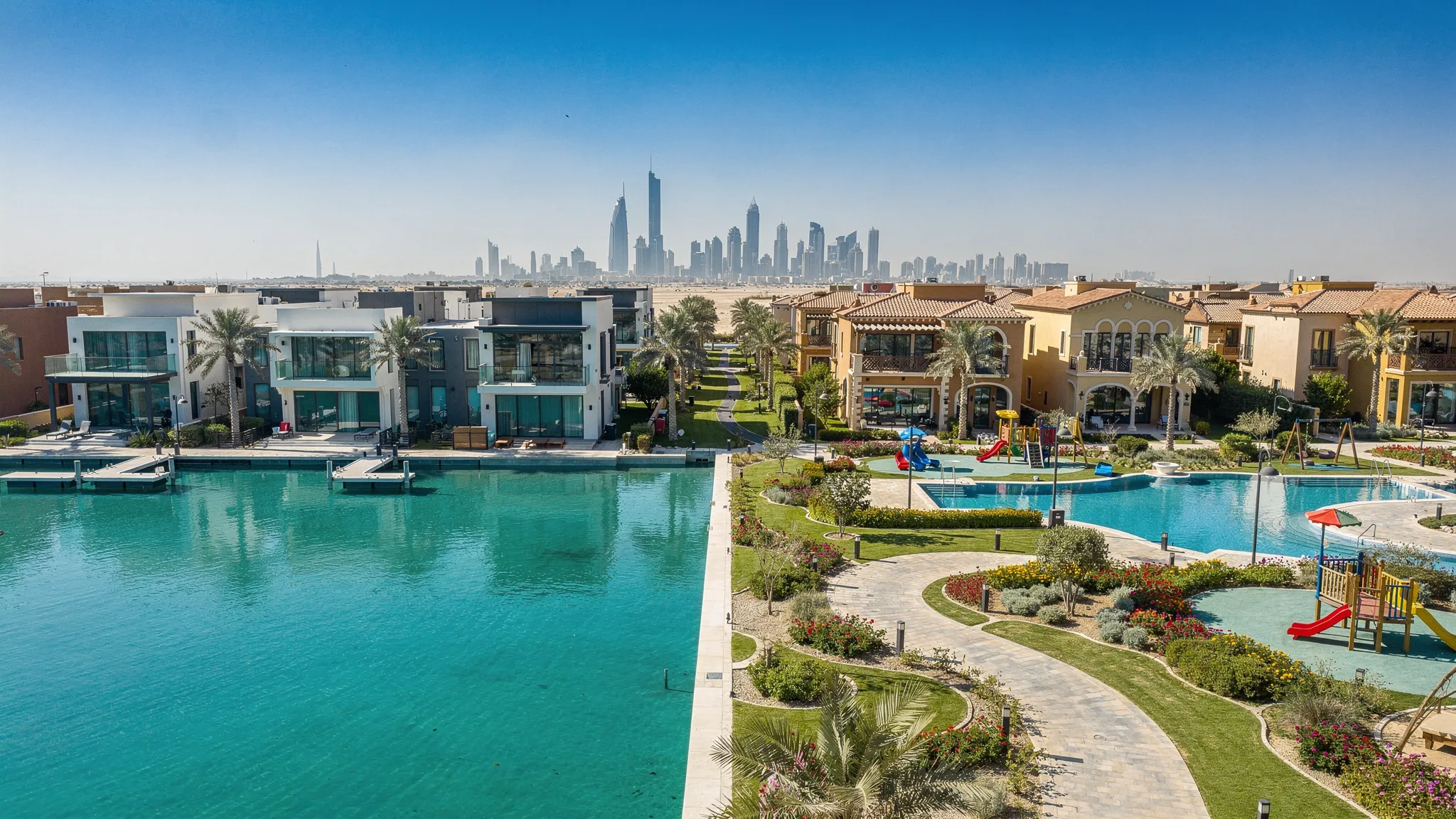
DAMAC Lagoons is a large, lifestyle-led villa and townhouse community, designed around themed clusters and lagoon-style leisure features. It has been heavily marketed to end-users (families) and long-hold investors who want a “community story” to support resale demand.
DAMAC Islands is positioned as a newer, premium lifestyle concept with a stronger “destination” narrative. In 2026, it attracts investors hunting for early-cycle uplift, brand-led demand, and the pricing momentum that can occur when a master community matures from launch phase to delivered reality.
Why These DAMAC Communities Are Popular in 2026
In 2026, Australian investors continue to focus on Dubai because of:
- Yield potential relative to many Australian metro markets.
- Developer payment plans that can reduce upfront cash pressure.
- Lifestyle-driven tenant demand (families, executives, and relocating entrepreneurs).
DAMAC communities, in particular, remain popular because they package a clear lifestyle proposition. That matters because in Dubai, tenants and buyers pay premiums for convenience, community facilities, and perceived “brand safety”.
Location Comparison: DAMAC Islands vs DAMAC Lagoons
Location is not only about a pin on the map. It is about commute friction, school and retail access, and future transport links.
- DAMAC Lagoons is widely perceived as a more established “known quantity” in terms of surrounding community context, with demand often supported by family-led rental profiles.
- DAMAC Islands typically draws interest from investors who want a newer masterplan story (and the potential repricing that can come with delivery milestones).
For ROI modelling, the key question is: which community’s location better matches your target tenant or future buyer? If you cannot clearly answer that, a consultation is the fastest way to avoid choosing a community for marketing reasons rather than cash-flow reasons.
Property Types & Prices Comparison
Both communities are predominantly villa and townhouse-led, which changes the ROI math versus apartments:
- Higher absolute purchase prices than studios or 1-bed apartments in many Dubai districts.
- Different tenant pool (often families), which can mean longer tenancies but higher maintenance expectations.
Because releases, layouts, and premiums change by phase, any “one-price-fits-all” comparison is unreliable. Instead, compare price per usable space, plot orientation, corner vs mid-unit positioning, and proximity to the community’s key amenities.
| Factor that changes “price” in practice | Why it affects ROI | What Australians often miss remotely |
|---|---|---|
| Phase and release timing | Early releases can price differently to later ones | Paying late-cycle pricing for an early-cycle story |
| Unit position (corner, park-facing, water-facing) | Impacts rentability and resale liquidity | Overpaying for a view premium that tenants will not fund |
| Handover timeline | Determines when income starts | Carrying costs and FX exposure during construction |
| Service-charge structure | Impacts net yield | Modelling gross yield only, ignoring ongoing costs |
Rental Yield Comparison in 2026
In general, completed and lease-ready stock tends to produce clearer, more bankable rental yield than off-plan stock that is still years from handover.
- DAMAC Lagoons can be compelling for investors prioritising family rental demand and longer lease profiles, especially once a cluster is delivered and operational.
- DAMAC Islands can be attractive if your plan is to capture capital uplift into or after delivery, then refinance or lease once the tenant ecosystem forms.
To keep this factual: rental yields in Dubai vary massively by handover status, exact unit type, and net-cost load (service charges, management, vacancy). Dubai Land Department transaction transparency helps, but you still need building and unit-level underwriting. You can start by reviewing official resources like the Dubai Land Department and then validating assumptions deal-by-deal.
Capital Appreciation Potential
Capital appreciation in master communities often tracks a familiar pattern:
- Launch pricing and early hype
- Construction progress and milestone repricing
- Handover, community activation, and comparable sales
- Maturity phase (resale market depth and stable buyer demand)
DAMAC Islands is typically viewed as the “earlier-cycle” play in 2026, where investors target pricing momentum as delivery clarity increases.
DAMAC Lagoons is often viewed as the “more progressed-cycle” play, where appreciation may be steadier and more comparable-led (less story-driven, more comps-driven).
ROI Comparison: Which Offers Better Returns?
ROI in 2026 should be assessed as total return, not just headline yield.
- If your goal is near-term rental income, the advantage usually goes to the community (and specific unit) that can be delivered, furnished, and leased faster.
- If your goal is capital growth, the advantage often goes to the option where you are buying earlier in the delivery and adoption curve, assuming the project execution stays on track.
The problem is that many investors compare two glossy brochures, then assume similar ROI. In reality, two villas in the same community can have very different net returns once you factor in service charges, snagging, landscaping, vacancy buffers, and leasing fees.
Payment Plans & Entry Costs
DAMAC projects often come with construction-linked payment plans, and sometimes post-handover components, depending on the release. For Australians, the “best” payment plan is the one that matches:
- Your AUD cash flow schedule
- Your FX conversion strategy (lump sum vs staged)
- Your financing pathway (developer plan, non-resident mortgage for eligible completed stock, or a hybrid)
Entry costs are not just the booking amount. You should budget for transaction fees, conveyancing/legal review, and ongoing ownership costs. (If you want to sanity-check the Dubai process end-to-end, Dubai Invest already covers this in detail across multiple buyer guides, and we can tailor it in a consultation to your exact unit.)
Target Buyers & Investor Profiles
DAMAC Lagoons typically suits:
- Family-led tenant strategy investors
- Longer hold investors who want community maturity
- Buyers who prefer comparables and operational stability over launch-phase volatility
DAMAC Islands typically suits:
- Growth-oriented investors who want earlier-cycle repricing potential
- Buyers comfortable underwriting delivery timelines and market cycle risk
- Investors aiming for a blended strategy (uplift plus rental once delivered)
Infrastructure & Future Developments
In Dubai, infrastructure impact is real, but it is also uneven. Two key points for 2026:
- Community activation matters: retail, access roads, and school options influence leasing velocity.
- Masterplan sequencing matters: the phase you buy into can determine noise, dust, and liveability for years.
A consultation is where we stress-test the specific release, not the community name. That is also where Jomon’s on-ground Dubai experience (both job and business experience in the market) becomes practical, because it helps filter what is real today versus what is only promised.
Lifestyle & Amenities Comparison
Lifestyle sells properties in Dubai, but it also supports rent.
- DAMAC Lagoons leans into a themed, family lifestyle proposition.
- DAMAC Islands leans into a newer, premium destination narrative.
Amenities only improve ROI if tenants will pay for them and if they reduce vacancy. Your underwriting should reflect that.
Risks to Consider Before Investing
Both options carry risks that can reduce ROI if ignored:
- Off-plan delivery risk (timeline shifts and market-cycle changes)
- Service-charge inflation impacting net yield (check how service charges are set and regulated through official channels like RERA)
- Liquidity risk if a unit type is over-supplied at resale
- FX risk for Australians (AUD movements can materially change your effective entry price)
A useful analogy is healthcare: you would not start a major orthodontic treatment based only on ads, you would want a plan, diagnostics, and a specialist consult. That is why premium providers emphasise digital planning and consultation, for example digital orthodontic consultations with 3D planning. Property investing at this scale deserves the same discipline.
DAMAC Islands vs DAMAC Lagoons: Pros and Cons
DAMAC Islands (high level):
- Pros: Potentially stronger early-cycle upside, newer concept appeal, brand-led momentum if delivery milestones are met.
- Cons: Higher uncertainty around timing, leasing ecosystem and comps until more phases mature.
DAMAC Lagoons (high level):
- Pros: Often easier to benchmark using community maturity and comparable activity, family-tenant positioning can support stable leasing.
- Cons: Some upside may already be priced in versus earliest releases, and net yield depends heavily on unit specifics and running costs.
Which Community is Better for Long-Term Investment?
For long-term investment, “better” usually means more resilient demand and deeper resale liquidity.
- DAMAC Lagoons can be compelling for investors who want a community that increasingly behaves like a “normal” suburb over time, with family demand supporting the resale market.
- DAMAC Islands can be compelling if you believe the project’s destination positioning will translate into sustained buyer demand after delivery, not just launch-period excitement.
Long-term winners are often decided at the unit level (layout, orientation, proximity to amenities), not the billboard name.
Which is Better for Rental Income?
For rental income in 2026, the practical edge often goes to:
- The unit that can be leased sooner, with lower downtime.
- The unit with the lowest net-cost burden, especially service charges and maintenance.
If you are targeting rental income from Australia, the operating plan matters: property management quality, leasing strategy, furnishing scope, and tenant profile. Dubai Invest can help you model net yield, not just gross, during a consultation.
Expert Verdict: Where Should You Invest in 2026?
If you want more predictable, underwriting-led rental outcomes, DAMAC Lagoons is often easier to model, assuming you select the right phase and unit and you budget correctly for net costs.
If you want growth-led ROI and are comfortable with execution and timing risk, DAMAC Islands can make sense, particularly if you are buying with a clear plan around payment milestones, FX timing, and an exit or refinance strategy.
The fastest way to choose correctly is to run a deal-specific ROI model (net yield, handover timing, vacancy buffers, service charges, and exit costs) and then sanity-check assumptions with someone who works on-ground. Jomon’s Dubai job and business experience is valuable here because it helps separate marketing narratives from real operational ROI drivers.
Start Your Dubai Property Investment Journey
If you are deciding between DAMAC Islands vs DAMAC Lagoons for ROI in 2026, book a consultation before paying any booking fee. Dubai Invest helps Australians invest in Dubai with end-to-end support, from deal shortlisting and ROI modelling to documentation, transfers, and post-purchase setup.
Get a personalised, numbers-first recommendation here: Dubai Invest
Frequently Asked Questions
Is DAMAC Islands or DAMAC Lagoons better for Australians investing remotely?
It depends on whether you prioritise near-term leasing (often easier with delivered stock) or medium-term uplift (often linked to project maturity). Remote buyers should focus on unit-level due diligence and a clear FX plan.
Can I rely on advertised ROI figures from sales brochures?
You should treat them as marketing, not underwriting. Always model net yield after service charges, management, vacancy, furnishing, and transaction costs.
Do villas and townhouses perform differently from apartments in Dubai?
Yes. They often target different tenant segments (families), can have different maintenance costs, and can behave differently in resale cycles.
What is the biggest mistake investors make when comparing these two communities?
Comparing community names instead of comparing the exact unit, phase, payment plan, timeline, and net-cost structure