UAE Personal Income Tax Rate 2026: Salary, Rental & Investment Income Explained
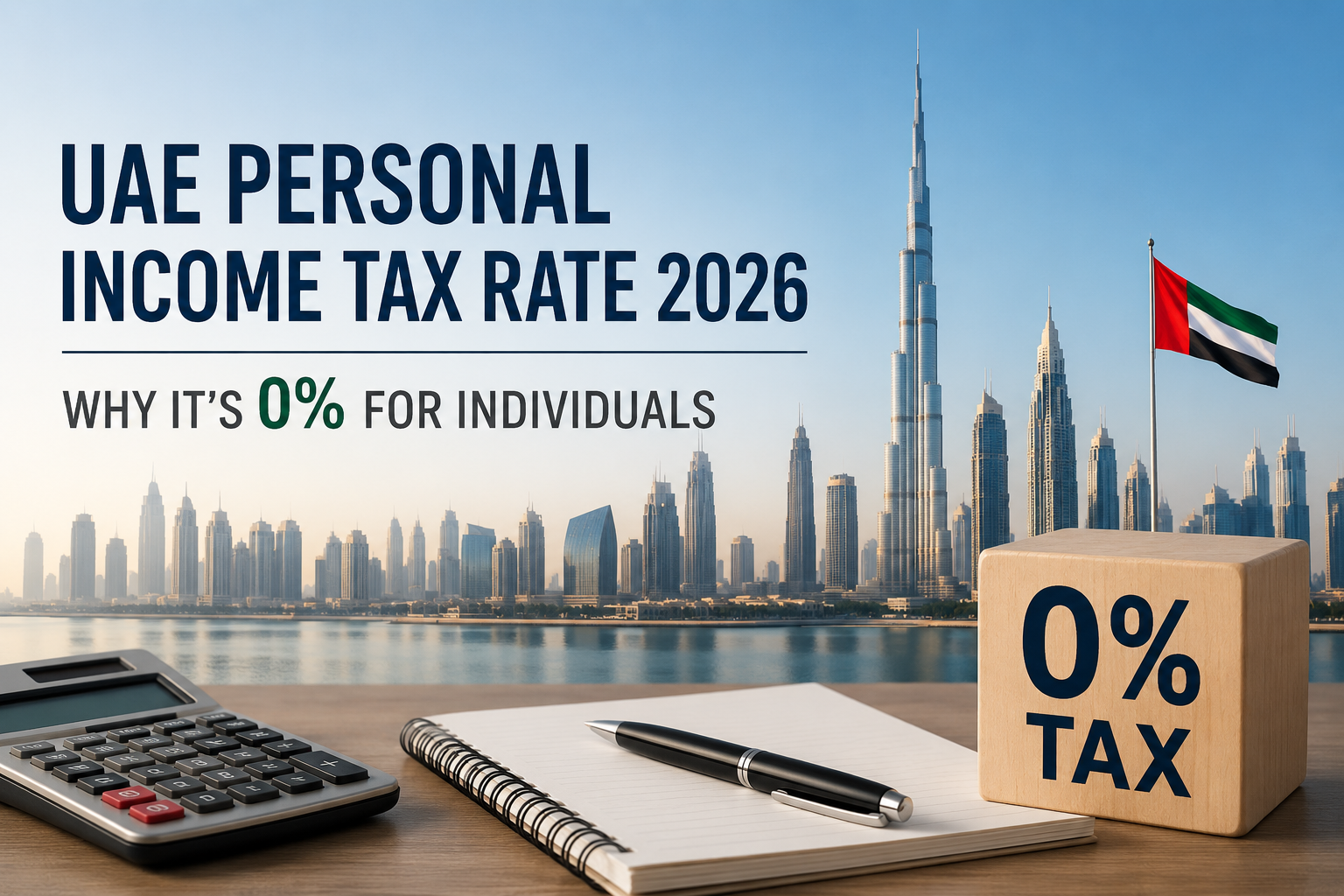
Quick answer : The UAE personal income tax rate in 2026 is 0% for individuals, with no tax on salaries, wages, freelance income, or investment returns. This applies to residents, expatriates, and UAE nationals.
UAE Personal Income Tax Rate 2026 (Overview)
The United Arab Emirates does not impose personal income tax at the federal level.
This means individuals working or residing in the UAE do not pay tax on employment income, freelance earnings, or personal investment income.
The following sections explain the official tax structure, exemptions, and how the UAE system operates in 2026.
UAE Personal Income Tax Rate for Individuals (Residents & Expats)
This breakdown shows how the 0% tax policy applies across different types of individuals.
The 0% income tax rate in the UAE applies universally to all individuals, regardless of nationality or residency status. Here is how it breaks down across different categories:
- UAE Nationals (Emiratis) – Pay zero personal income tax on all earnings.
- UAE Residents (Expats on Residency Visas) – Pay zero personal income tax on UAE-sourced income. Their home country’s tax rules may still apply depending on their tax residency status and double taxation treaties.
- Freelancers and Self-Employed Individuals – Freelance income earned in the UAE is not subject to personal income tax.
- Investors and Passive Income Earners — Dividends, rental income, and capital gains received by individuals are not taxed under a personal income tax framework.
- Short-Term Workers and Contractors – Income earned during assignments in the UAE is not subject to UAE personal income tax, regardless of contract duration.
⚠️ Important Note for Expats: While the UAE imposes no personal income tax, your country of origin may still tax your worldwide income. For example, US citizens are taxed on global earnings regardless of where they live. Always consult a qualified tax adviser regarding your home country's obligations.
UAE Personal Income Tax Rate by Income Type in 2026
Not all income is treated the same way in the UAE. While the UAE personal income tax rate remains 0% for most individuals, the tax position can vary depending on how income is earned and whether activities fall under business or corporate tax regulations.
The table below provides a practical overview of how different income categories are generally treated in 2026.
| Income Type | Typical UAE Tax Position |
|---|---|
| Salary & Employment Income | 0% Personal Income Tax |
| Annual Bonuses | 0% Personal Income Tax |
| Investment Dividends | Generally 0% |
| Capital Gains (Individuals) | Generally 0% |
| Rental Income (Individuals) | Generally 0% |
| Freelance Income | Depends on structure and licensing |
| Business Profits | May fall under Corporate Tax rules |
| Company Income | Corporate Tax may apply |
While most personal income remains tax-free, income generated through business activities may require a separate tax assessment. Understanding the distinction between personal income and business income is essential before assuming all earnings qualify for 0% taxation.
UAE Personal Income Tax Rate on Salary and Employment Income
Employment income – including monthly salaries, bonuses, commissions, housing allowances, and other benefits in kind is entirely exempt from personal income tax in the UAE.
This means your UAE payslip reflects your gross salary as your take-home pay (before any voluntary deductions such as pension contributions for some nationals). For a more detailed explanation, read our guide on whether salaries are tax free in Dubai in 2026 There is no income tax line on a UAE salary statement, because there is no income tax to apply
All income types in the UAE are exempt from personal income tax as shown below:
| Income Type | UAE Personal Tax Rate | Status |
|---|---|---|
| Monthly Salary | 0% | Tax Free |
| Annual Bonus | 0% | Tax Free |
| Freelance / Self-Employment | 0% | Tax Free |
| Rental Income (Individual) | 0% | Tax Free |
| Investment Dividends | 0% | Tax Free |
| Capital Gains (Individual) | 0% | Tax Free |
When Does the UAE's 0% Personal Income Tax Rate Not Apply?
The UAE’s 0% personal income tax rate is often misunderstood as meaning every type of income is automatically tax-free. In reality, certain activities may fall outside the personal income tax framework and into other regulatory regimes.
Examples include:
- Operating a licensed business
- Running a consultancy through a company structure
- Generating business profits through a free zone entity
- Certain commercial activities carried out by freelancers
- Activities subject to UAE Corporate Tax requirements
In addition, foreign nationals may still have tax obligations in their home country depending on residency status and local tax laws.
Before relying on a 0% tax assumption, it is important to assess how income is generated and whether any corporate or overseas tax obligations may apply.
UAE Personal Income Tax Rate for Australians Living in Dubai
Many Australians move to Dubai expecting all income to become completely tax-free. While the UAE does not impose personal income tax, Australian tax obligations may continue depending on individual circumstances.
Important factors may include:
- Australian tax residency status
- Source of income
- Business ownership structures
- Overseas reporting requirements
- Capital gains implications
The UAE’s 0% personal income tax environment can offer significant advantages, but Australians should consider both UAE and Australian tax rules before making financial or relocation decisions.
United Arab Emirates Personal Income Tax Rate (Full Breakdown)
The UAE does not impose personal income tax on individuals in 2026. All forms of personal earnings – including salaries, freelance income, rental income, and capital gains – remain fully tax-free.
The UAE’s tax-free personal income system is a key factor behind its global appeal for professionals, expatriates, and international investors.
Why Many Expats Misunderstand the UAE's 0% Tax Rate
The phrase “tax-free UAE” often creates unrealistic expectations.
Common misunderstandings include:
Myth: The UAE has no taxes at all.
Reality: Corporate Tax and VAT still exist.
Myth: Moving to Dubai automatically removes home-country tax obligations.
Reality: Tax residency rules vary by country.
Myth: All freelance income is automatically tax-free.
Reality: Some business activities may fall under corporate tax regulations.
Myth: A free zone company guarantees 0% tax.
Reality: Tax treatment depends on compliance, structure, and qualifying income requirements.
Understanding these distinctions helps individuals make informed decisions and avoid costly assumptions.
Frequently Asked Questions
Do expats pay personal income tax in the UAE?
No. Expats in the UAE do not pay personal income tax on UAE-sourced income.
Is UAE personal income tax officially confirmed by the government?
Yes. The UAE does not impose personal income tax under federal law, and no official announcement has been made introducing it in 2026.
Why does the UAE not have personal income tax?
The UAE funds its economy through corporate tax, VAT, and natural resources, allowing individuals to remain tax-free on personal income.
Does the UAE personal income tax rate apply to freelancers?
The UAE does not impose personal income tax on freelance income. However, depending on how the activity is structured and licensed, certain business activities may fall within the scope of UAE Corporate Tax regulations.
Can Australians still be taxed after moving to Dubai?
Potentially, yes. Australian tax obligations depend on factors such as tax residency status, income sources, and individual circumstances. Professional advice should be obtained before relying solely on the UAE’s tax-free environment.
Is rental income taxed in the UAE?
Rental income earned by individuals is generally not subject to personal income tax in the UAE. However, investors may still incur property-related costs, service charges, and municipality fees.
Does the UAE tax dividend income?
Dividend income received by individuals is generally not subject to personal income tax in the UAE. Tax treatment may vary if income is earned through specific corporate structures.
Does a Dubai free zone company guarantee 0% tax?
No. A free zone company does not automatically qualify for 0% taxation. Tax treatment depends on factors such as business activity, qualifying income requirements, and ongoing compliance obligations.