How Australians Can Get Dubai Golden Visa via Real Estate 2026
Why the Dubai Golden Visa Matters for Australians in 2026
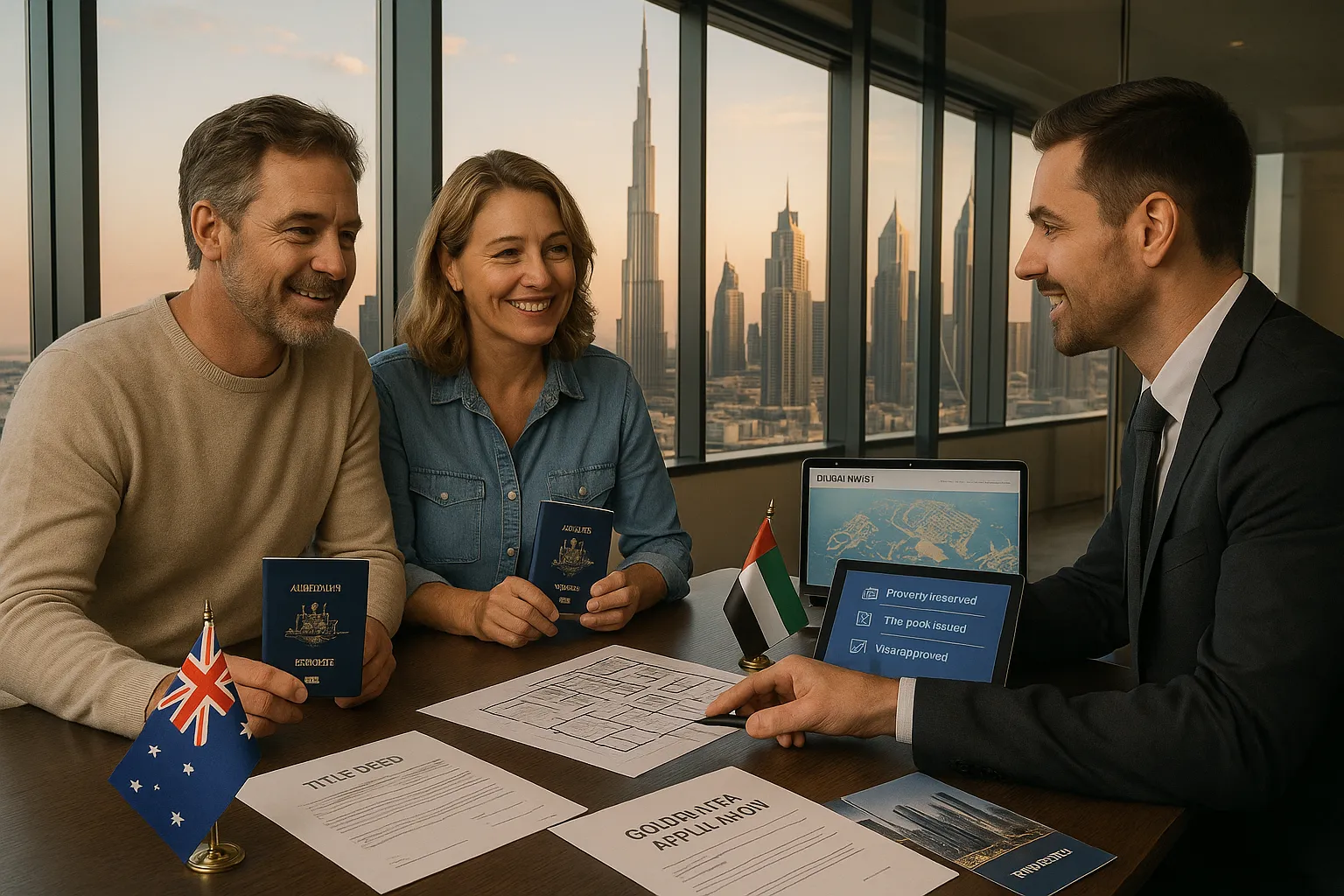
Dubai’s Golden Visa allows eligible Australians to secure long-term UAE residency through qualifying real estate investment. In 2026, the most common pathway is purchasing eligible Dubai property worth at least AED 2 million, subject to current regulations.
With a renewable 10-year residency, access to Dubai’s growing property market, and the UAE’s tax-efficient environment, more Australians are using real estate investment to support lifestyle flexibility, family planning, and international diversification.
This guide explains how Australians can qualify for a Dubai Golden Visa through property investment in 2026, including eligibility requirements, costs, off-plan vs ready property options, mortgage rules, and the step-by-step application process.
What is Dubai Golden Visa for Australians ?
| Key Question | 2026 Snapshot for Australians |
|---|---|
| Main property route | Own eligible Dubai property or combined properties worth at least AED 2 million, subject to current authority rules. |
| Visa duration | 10 years, renewable if eligibility is maintained. |
| Can Australians apply remotely? | Yes, much of the property purchase can be coordinated remotely, but medical, biometrics and Emirates ID steps usually require UAE presence. |
| Can family be included? | Yes, eligible dependants can usually be sponsored, subject to documentation and insurance requirements. |
| Best first step | Book a consultation before paying a deposit, especially if using finance, off-plan property or multiple assets. |
What Is the Dubai Golden Visa 2026?
The Dubai Golden Visa is a long-term UAE residency pathway for qualifying investors, entrepreneurs, professionals, exceptional talents and other approved categories. For Australian investors, the property route is one of the most practical options because it can connect real estate investment with residency planning.
The UAE Government outlines Golden Visa categories through its official portal, including the real estate investor pathway. You can review the broad framework on the UAE Government Golden Visa page, but property-specific execution in Dubai still needs careful checking with the relevant authority, developer, bank and land registration records.
Key Benefits of the UAE Golden Visa in 2026
The main appeal is stability. Australians who invest in Dubai often want more than a single purchase. They want a compliant structure that supports lifestyle, family access and future opportunities.
- 10-year renewable residency.
- Tax-free personal income framework in the UAE — while remembering Australian tax residency rules may still apply.
- Long-term stability for investors who want a base in the Middle East.
- Expanded eligibility pathways, including qualifying property and, in some cases, combined property assets.
A Golden Visa can also make routine UAE matters easier — including opening bank accounts, arranging utilities, sponsoring family members and spending extended time in Dubai without relying on short-stay visitor entries.
Dubai Golden Visa Eligibility for Property Investors: 2026
- Minimum investment: AED 2 million (≈ AU$830,000 — update conversion rate at publish time).
- Property type: Completed or off-plan units in approved freehold areas.
- Ownership structure: Solo ownership, joint with spouse, or via a UAE-based company for asset-protection purposes.
- Financing: Mortgages are allowed as long as the paid-up equity equals at least AED 2 million — verified by the lending bank.
- Age & nationality: No upper-age limit; all Australian passport holders qualify, including dual citizens.
- Duration & renewals: 10-year visa, renewable indefinitely as long as you keep the asset.
- 2026 update: The UAE’s Federal Authority for Identity, Citizenship, Customs & Port Security (ICP) now lets investors combine the value of two properties to meet the AED 2 million threshold — great news if you’re eyeing separate units for living and letting.
Eligible Property Types in 2026
Completed properties are usually simpler because the title deed and valuation position are clearer. Off-plan properties may be considered where they are properly registered and meet current Golden Visa rules, but the process can depend on the developer, project registration, payment status and authority requirements. Before booking an off-plan unit for Golden Visa purposes, confirm whether the project, payment stage and documents will support the application.
Ownership Rules for Australian Investors
Australians can generally buy property in Dubai’s designated freehold areas. These include many popular investment locations such as Downtown Dubai, Dubai Marina, JVC and Dubai South.
Ownership can be individual, joint or through certain entities, but Golden Visa eligibility may differ depending on the structure. If buying with a spouse, business partner, SMSF-related structure or company, get advice before signing — the applicant’s qualifying share matters.
Mortgage Rules for Non-Residents in 2026
Non-resident home loans are available in the UAE for eligible Australian buyers, but loan-to-value ratios, income criteria and document requirements vary by lender. Mortgaged property can sometimes support Golden Visa eligibility, but banks may need to issue supporting letters and the equity and value position must be clear.
A loan that works for purchase affordability may not be ideal for visa timing unless the bank, title, valuation and application sequence are aligned. This is where consultation matters most.
2026 Update: Combining Multiple Properties for Eligibility
Many Australian investors consider combining multiple Dubai properties to reach the AED 2 million level. This can be useful if you prefer several rental units instead of one premium asset.
The risk is documentation. Each property must be registered correctly, the values must be accepted, and mortgage or off-plan conditions need review. A consultation before purchase can prevent a portfolio that performs financially but falls short administratively.
Why Australians Prefer Dubai Real Estate for Golden Visa in 2026
Tax Efficiency and Global Mobility
Dubai remains attractive because the UAE does not levy personal income tax on most individuals. For Australians, this can be powerful — but it does not automatically remove Australian tax obligations. If you remain an Australian tax resident, the ATO may still require you to report foreign rental income and capital gains. The investment structure should be planned with both UAE and Australian tax advice from the outset.
High Rental Yields in Dubai (2026 Market Trends)
Dubai rental yields can be higher than many Australian capital-city residential markets, especially in well-selected apartment communities. Australians favouring rental returns or a rapid relocation typically lean towards completed freehold apartments in Dubai Marina, Downtown or JVC, where gross yields have hovered around 7%. Mid-market areas often attract investors because entry prices are lower and tenant demand is broad.
The number that matters is net yield, not advertised gross yield. Service charges, vacancy, management fees, furnishing, maintenance and currency conversion can change the final return significantly.
Fast Processing Compared to Other Countries
Once the right property documents are in place, the Golden Visa process can be relatively efficient compared with many long-term residency programmes. However, delays still happen when investors miss attestations, bank letters, title records or source-of-funds documentation. Speed comes from preparation — the strongest applications are planned before the property deposit is paid.
Best Areas in Dubai for Golden Visa Property Investment (2026)
Downtown Dubai
Downtown Dubai suits investors who want premium positioning, strong tenant appeal and global recognition. Prices are higher, so the AED 2 million threshold may be easier to reach with a single asset. It suits long-term capital preservation, luxury rentals and investors who value liquidity in a landmark location.
Dubai Marina
Dubai Marina remains popular with expatriates, professionals and short-stay tenants. It offers lifestyle appeal, transport access, waterfront positioning and a deep resale market. For Golden Visa investors, the key is choosing the right building — service charges, view, parking, maintenance history and operator rules can significantly affect net returns.
Jumeirah Village Circle (JVC)
JVC is often attractive for yield-focused Australian investors. Entry prices are more accessible than prime waterfront locations, and tenant demand is supported by affordability and community growth. The main due-diligence focus should be developer quality, building completion, service charges and realistic rent assumptions.
Dubai South (Emerging Growth Zone)
Dubai South is a longer-term growth play linked to infrastructure, logistics, aviation and expanding residential demand. It may suit investors with a multi-year horizon and comfort with emerging-area risk. Those looking for capital appreciation may opt for off-plan launches in this corridor. For Golden Visa planning, confirm whether the selected asset and payment stage meet eligibility requirements before committing.
| Factor | Off-Plan (Under Construction) | Ready Unit |
|---|---|---|
| Purchase Price | 10–20% lower launch prices | Premium for immediate usability |
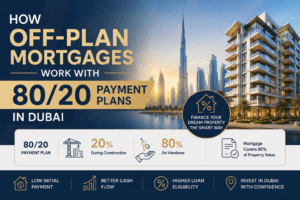
| Payment Schedule | Staggered payments (e.g. 60/40) | 100% payment on transfer |
| Golden Visa Timing | Depends on project registration, developer status and payment stage — visa issued once 60% of value is paid and developer certificate released | Usually clearer — visa obtainable within 4–6 weeks of transfer |
| Rental Income | Starts post-handover | Immediate rental yield |
| Risk Profile | Developer delay, handover quality and market-cycle risk | Lower delivery risk, but condition and service charges must be checked |
| Mortgage Access | More limited, depending on project and bank policy | Generally easier for non-resident mortgage assessment |
| Best For | Capital growth and flexible payments | Faster visa planning and income certainty |
Which Option Is Better for Australians in 2026?
If the priority is Golden Visa speed, a ready property is often the cleaner path. If the priority is capital growth and staged cash flow, off-plan can work — but only after project registration, escrow, developer track record and visa eligibility are fully checked.
For many Australians, the better answer is not simply off-plan or ready. It is the property that matches your visa timeline, funding method, tax position and exit plan.
Step-by-Step Process to Get a Dubai Golden Visa from Australia (2026)
1. Consultation & Investment Planning
Start with a consultation before you shortlist property. This is where your budget, visa goal, family needs, funding method, Australian tax position and ideal holding period are mapped together. Dubai Invest offers a complimentary 30-minute consultation to clarify your options and match strategy to goals.
2. Property Selection & Booking
Once the strategy is clear, select properties that fit both investment and Golden Visa objectives. This means checking location, developer, building quality, title pathway, service charges and rental demand. A booking should only happen after eligibility risks are fully understood — reserve with a refundable 5–10% booking fee.
3. Legal Due Diligence & Compliance Checks
Due diligence should verify seller authority, developer status, Dubai Land Department records, escrow account details, title or Oqood status, and payment obligations. For remote Australian buyers, this stage also includes source-of-funds preparation and document sequencing. Seller and developer title, escrow compliance and service-charge review are all part of this step.
4. Payment, Escrow & Funds Transfer
Funds should be transferred only through traceable channels to verified escrow, trustee, developer or seller accounts. Telegraphic transfer from Australia to an RERA-approved escrow account is standard. Documentary proof of currency exchange often speeds up clearance. Avoid personal accounts and last-minute changes to bank details. Dubai Invest can help coordinate money transfer support from Australia to Dubai so settlement timing and documentation are aligned.
5. Title Deed Registration (Dubai Land Department)
For ready property, the title deed is registered through the Dubai Land Department. For off-plan, an Oqood is issued. The government transfer fee is 4% of the property price plus AED 580 administration. You can learn more about official property services through the Dubai Land Department, but buyer-side interpretation and document checking still require on-ground experience.
6. Golden Visa Application Submission
After property documents are ready, the Golden Visa application can be prepared. The file may include passport copies, property documents, DLD valuation, Emirates ID photos, existing UAE visa status if applicable, health insurance and any supporting letters required. Errors at this stage can delay approval — review every document before submission. Visa stamping is now fully digital — no passport collection required.
7. Biometrics, Medical & Emirates ID
Applicants generally complete a UAE medical fitness test, biometrics and Emirates ID steps. Some steps require UAE presence, even if the property purchase was arranged remotely. The process typically takes 48 hours once in the UAE. Plan travel around appointment availability rather than assuming everything can be done in a single day.
8. Family Sponsorship
Once the main applicant’s visa is approved, eligible family members can usually be sponsored — spouse, children under 25, and parents (if you meet AED 20k per month income proof). Marriage certificates, birth certificates and other documents may need proper attestation. Family applications should be planned early because missing attestations are one of the most common causes of delay.
Total timeline for a ready unit purchase: 4–6 weeks from offer to residence permit.
| Item | Amount (AED) | Approx. AUD |
|---|---|---|
| Land Department Transfer Fee (4%) | 80,000 | 33,250 |
| Admin & Title Deed | 580 | 240 |
| Knowledge & Innovation Fees | 580 | 240 |
| Golden Visa File Opening | 2,200 | 910 |
| Medical & Biometrics | 1,165 | 480 |
| 10-Year Visa Issuance | 3,860 | 1,600 |
| Emirates ID (10 yrs) | 2,150 | 890 |
| Total (single applicant) | 90,535 | 37,610 |
Family add-ons:
- Spouse: ~AED 5,000 inc. ID
- Child: ~AED 3,800
- Parent: ~AED 6,500 (two-year renewable)
The figures above are indicative budgeting ranges only. Government fees, insurance, medical charges and service fees can change — request a current quote during consultation. These government fees do not include agency or legal charges, which vary by service scope. Dubai Invest bundles all filings, attestation and translation into a flat service retainer, quoted upfront before engagement.
A family budget should include visa applications, Emirates IDs, insurance, attestations and any typing or processing fees. The safest approach is to quote the full family file before buying.
Remote Buyers: How Australians Can Complete the Process from Australia
Video Power of Attorney (POA) System
Since 2024, Dubai Notary Public accepts live video POA from Australian residents, removing the need for embassy visits. However, POA acceptance depends on the document, authority and execution method. Some investors can use online notarisation or video processes, while others may need Australian notarisation, DFAT authentication, UAE legalisation and MOFAIC attestation.
Do not use a generic POA. It should be drafted specifically for the property, bank, developer, trustee or DLD requirement involved.
Fully Digital Property Registration
Dubai has continued to digitise real estate services, including digital records and app-based verification. Buyers financing with Emirates NBD or Mashreq can also secure an Ejari (tenancy contract) online — a prerequisite for family visas. This helps remote buyers track ownership records and transaction status.
Still, digital does not mean risk-free. Always verify escrow, title, seller authority, service charges and contract terms before transferring funds.
UAE Tax Residency Certificate (ATO Relevance)
Australians avoiding dual-tax complications can request a UAE Tax Residency Certificate after 183 days of presence — useful for ATO declarations. However, a Golden Visa does not automatically make you a UAE tax resident, and a UAE Tax Residency Certificate does not automatically end Australian tax residency. The ATO looks at facts such as home, family, business ties, intention and time spent overseas. Australians should review ATO guidance on residency and foreign income with a qualified tax adviser before relying on Dubai residency for tax planning.
Tax Implications for Australians Investing in Dubai (2026)
Capital Gains Tax Considerations (ATO Rules)
The UAE does not levy capital gains tax on most individual residential property sales, but Australian tax residents are generally taxed on worldwide capital gains — including gains from Dubai property. Keep purchase contracts, transfer records, FX conversion rates, improvement invoices, rental statements and sale documents. Poor records can make ATO reporting more difficult later.
Residency Status Impact on Tax Obligations
Australian tax residency is a facts-based test. Having a Dubai Golden Visa, Emirates ID or UAE bank account does not automatically make you non-resident for Australian tax purposes. Before investing, speak with a cross-border tax adviser. The right property structure, funding method and record-keeping process can prevent major problems later.
Can You Rent or Use Airbnb with Golden Visa Properties in 2026?
Yes, you can generally rent out a Golden Visa-linked property, subject to building rules, community regulations and Dubai licensing requirements. Long-term rentals usually involve Ejari registration, while short-term rentals require holiday-home compliance through the relevant Dubai tourism authority.
Airbnb-style income can be attractive in the right locations, but it is more operationally intensive. Furnishing, guest management, permits, dynamic pricing, cleaning and vacancy must all be modelled properly. For Australians living overseas, professional property management is usually essential.
Can You Sell the Property and Keep the Golden Visa?
Do not assume you can sell the qualifying property and automatically keep the Golden Visa for the full remaining period. The visa is linked to meeting eligibility requirements, and rules can be reassessed at renewal or if status changes are reviewed.
If you plan to sell, refinance or replace the property, sequence the transaction carefully. Many investors aim to buy a replacement qualifying asset before disposing of the original — but the correct approach depends on title timing, valuation, mortgage status and immigration rules at the time. This is a legal and administrative planning issue, not just a sales decision. Get advice before signing a sale agreement.
| Feature | Dubai Golden Visa via Property | Free Zone Investor Visa |
|---|---|---|
| Typical Duration | 10 years, renewable if eligible | Usually shorter — linked to company licence and immigration file |
| Main Basis | Qualifying property investment | Shareholder or investor status in a UAE company |
| Business Requirement | No operating business required | Requires company setup, licence renewal and compliance |
| Flexibility | Strong for investors wanting residency without running a company | Strong for founders who need UAE operations, invoicing, hiring or banking |
| Family Sponsorship | Usually available subject to requirements | Usually available subject to visa quota, salary or authority rules |
| Best Suited To | Property investors, family planners, global mobility seekers | Entrepreneurs, consultants, e-commerce founders and SMEs |
How Dubai Invest Supports Australian Investors (2026)
Dubai Invest helps Australians move from research to execution with a practical, end-to-end approach. The goal is not just to buy property — it is to buy the right property, structure it correctly and avoid delays across banking, documents and visa processing.
Property Selection Based on ROI Data: Dubai Invest assists with shortlisting properties based on area demand, expected rent, service charges, developer quality, resale liquidity and Golden Visa suitability — including curated virtual or in-person tours using live ROI data. This helps you avoid buying only because a project is being heavily marketed.
Legal & Banking Assistance: The team can coordinate legal documentation, source-of-funds preparation, non-resident home loan support, money transfers from Australia to Dubai and document handling — including POA drafting, DFAT and MOFAIC attestations and Arabic translation. This is especially valuable for Australians dealing with time zones, bank compliance and unfamiliar UAE processes.
End-to-End Visa Processing Support: Dubai Invest can guide the Golden Visa pathway from eligibility planning through property documents, application preparation, medical steps, Emirates ID and family sponsorship. Jomon’s practical job and business experience in Dubai gives clients real insight into how decisions are handled locally — not just what appears on paper.
Post-Purchase Property Management: After purchase, Dubai Invest can assist with tenant sourcing, snagging inspections, service-charge audits, leasing strategy and ongoing ownership planning. The real return starts after settlement, when service charges, vacancies, maintenance and tenant quality affect cash flow.
Planning a fact-finding trip? Combine due diligence with networking at our upcoming Grand Business Conference to meet developers and legal experts under one roof.
Final Thoughts – Is the Dubai Golden Visa Right for Australians in 2026?
The Dubai Golden Visa can be a strong option for Australians who want long-term UAE residency, property exposure, family flexibility and a base in one of the world’s most active investment hubs.
But the best outcomes come from planning before purchase. Eligibility, finance, title structure, ATO implications, family documents and rental strategy should all be reviewed together — not separately.
If you are considering a Dubai Golden Visa through property investment, book a consultation with Dubai Invest before paying a deposit. A tailored session can help you understand your budget, suitable areas, visa pathway, remote buying process and key risks.
Ready to Start?
Book a free discovery call and receive a personalised investment report — including potential properties already pre-qualified for Golden Visa eligibility.
Start with the right advice, then invest with confidence. Your gateway to Dubai from Australia.
Frequently Asked Questions
Can I sell the property and keep my Golden Visa?
No. You must always hold AED 2 million worth of property. If you sell, a 6-month grace period is granted to reinvest or downgrade your residency.
Does the Visa grant work rights?
Yes, Golden Visa holders may work, start a company or freelance without a local sponsor.
What about Australian capital-gains tax?
Property held personally in the UAE is outside Australian CGT unless you remain an Australian tax resident. Seek tailored advice on residency status.
Can I rent out the property on Airbnb?
Short-term letting is legal in most freehold areas with a tourism permit (≈ AED 1,500 per year). Yields can exceed 10% in peak season.
Is the Golden Visa better than a Free Zone Investor Visa?
Free-zone visas last 2–3 years and tie you to company renewals. The Golden Visa is asset-based, longer, and doesn’t require annual audits, making it more hands-off for passive investors.