How Australians Can Hedge Currency Risk in UAE Real Estate
Why currency risk is the quiet deal-breaker
For Australian investors, the appeal of UAE real estate is obvious: zero income tax on rental returns, yields that regularly exceed 7 %, and a booming expat population that keeps occupancy rates high. Yet there’s a hidden variable that can wipe out those gains: the AUD ↔ AED exchange rate.
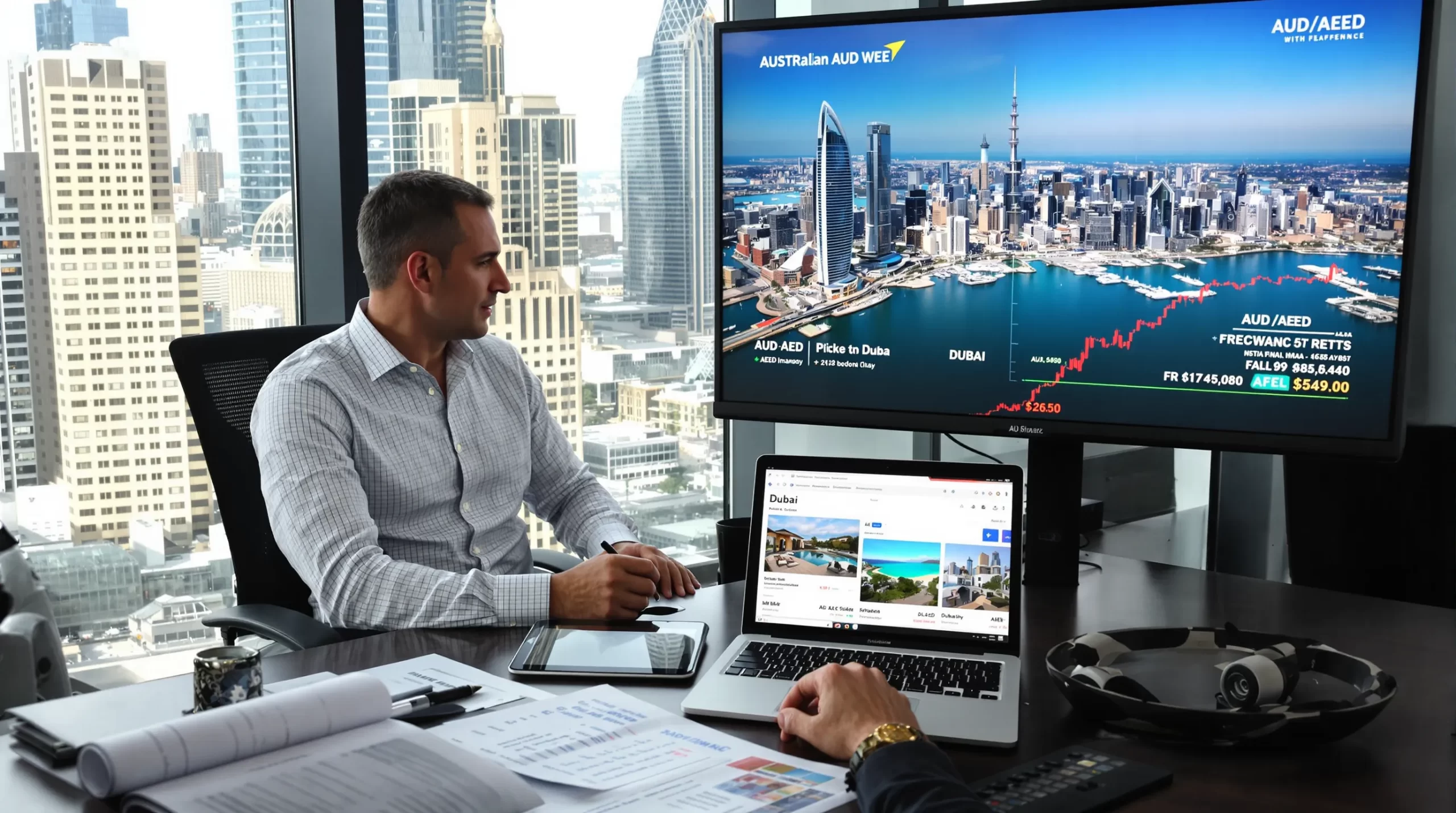
A swing of only 5 % between exchanging your dollars and repatriating your returns can mean the difference between beating or lagging the ASX-200. Because most Dubai property transactions, developer instalments and service charges are denominated in UAE dirhams (AED), understanding—and actively managing—currency exposure is critical.
This guide breaks down practical hedging techniques Australians can use in 2025 and beyond. We focus on mid-sized investors (A$500 k–A$5 m) purchasing directly or through an SPV, but the principles apply whether you’re buying a studio in Business Bay or funding a luxury villa on Palm Jebel Ali.
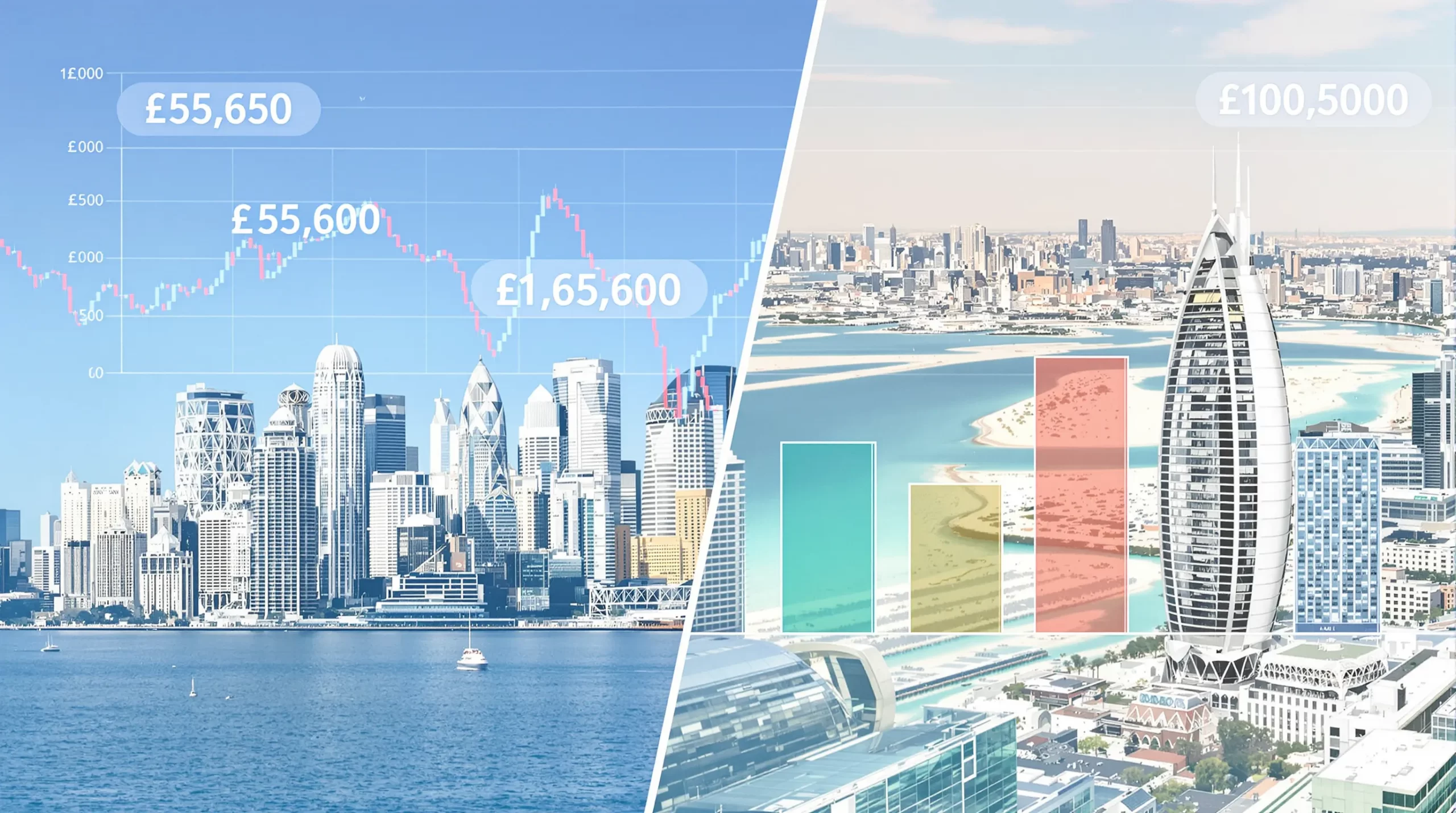
1. Know the AUD/AED dynamics first
- The UAE dirham is pegged to the US dollar at 3.6725 AED = 1 USD.
- AUD ↔ USD is therefore the real moving part. Over the past decade the Aussie has traded between USD 0.55 and USD 0.81, a 47 % band.
RBA data show that a property purchased for AED 2 m when the AUD is at 0.70 USD costs roughly A$760 k. If the AUD drops to 0.60 USD by completion, the same AED outlay equals A$888 k—an extra A$128 k simply from FX.
Key takeaway
Locking in rates (or building natural hedges) is not speculation—it’s risk management.
2. Quantify your exposure
Before you call a broker, map out:
- Cash outflows: deposits, construction instalments, land department fees, service charges.
- Recurring inflows: rental income, resale proceeds.
- Timing: off-plan schedules can span 3–5 years; villa refurbishments maybe 9 – 12 months.
Create a table with anticipated AED amounts and due dates. Your hedge should match those flows, not some generic annual figure.
3. Forward contracts: the workhorse hedge
A forward lets you fix today’s AUD rate for a future date (or series of dates). Australian banks like NAB, Westpac and specialist platforms such as OFX or Western Union Business Solutions quote AUD/USD forwards that indirectly cover AED exposure.
Pros:
- Simple, transparent pricing.
- No upfront premium.
- Ideal for fixed payment milestones (e.g., 10 % on signing, 10 % every 6 months).
Cons:
- You must deliver the full amount on the forward date—even if your plans change.
- Opportunity cost if AUD strengthens.
Tip: Use a window forward that gives a 30-day settlement band if your developer’s call dates are unpredictable.
4. Currency options for flexibility
A call option on USD (which equates to selling AUD) protects you against AUD weakness but lets you benefit if the Aussie rallies.
Pros:
- Downside protection, upside participation.
- You can hedge only the “tail risk” portion (e.g., 30 % of exposure) to reduce cost.
Cons:
- You pay an upfront premium—typically 1–3 % of nominal value.
- Pricing can be opaque; work with a broker that provides a full Greeks breakdown.
Options make sense for lump-sum settlements such as final handover or bulk land payments.
5. Borrow in AED (local mortgage or corporate loan)
Taking debt in dirhams naturally offsets currency risk because your liability and the asset are in the same currency.
- Australian residents can access non-resident mortgages from Emirates NBD, Mashreq and Abu Dhabi Islamic Bank up to 50–60 % LTV.
- Rates (as of July 2025) hover around EIBOR + 2.25 %, translating to ~6.5 % fixed for three years.
If the AUD falls, the capital value of your loan in Australian dollars rises—but so does the property’s dirham value, leaving net equity broadly hedged.
6. Use rental income as a natural hedge
If you intend to hold and lease the property, keep that income in AED rather than converting monthly. Rental yields can pay your service charges, mortgage and maintenance in local currency, minimising transfers. Only repatriate when AUD strength provides a favourable window.
Platforms such as Wise, Revolut Business and HSBC Global Wallet allow you to maintain AED balances while offering competitive FX spreads when you do convert.
7. Diversify purchase tranches
Developers often permit staged payments beyond the standard 10/10/80 schedule if you negotiate. Spreading FX conversions over 12–24 months lowers the risk of mistiming the market.
Another tactic is dual-currency funding: pay the land component upfront (hedged with a forward) and finance the build cost in AED. This splits exposure between fixed and floating rates.
8. Multi-currency accounts & limit orders
Holding an AUD and AED wallet with the same provider allows you to park funds and set automated limit orders. For instance, instruct a sale of AUD when AUD/USD trades at 0.73. This removes emotion and time-zone issues (Dubai trades while Sydney sleeps).
9. Putting it together: a sample hedge plan
Scenario: You reserve an off-plan apartment priced at AED 2.4 m with the following schedule.
| Milestone | AED | Date |
|---|---|---|
| Booking (10 %) | 240 000 | 01 Sep 2025 |
| 6 months | 240 000 | 01 Mar 2026 |
| 12 months | 240 000 | 01 Sep 2026 |
| Handover (70 %) | 1 680 000 | 01 Sep 2028 |
Hedge mix:
- Booking & 6-month instalment: lock via a 12-month forward at today’s AUD/USD.
- 12-month instalment: buy a USD call option (cost 2 % premium) covering half the amount; convert spot for the other half.
- Handover: finance 50 % via an AED mortgage, rate capped with an interest-rate collar; layer quarterly forwards for remaining equity over 2027–28.
Result: 70–80 % of exposure is covered, premium outlay limited to 1 % of total deal value.
10. Tax and regulatory considerations
- The ATO treats FX gains/losses on foreign property as capital if tied to the asset’s sale or as revenue if related to rental income. Consult a tax adviser to utilise the capital gains tax (CGT) discount where applicable.
- UAE Central Bank requires any AED mortgage for non-residents to be insured; the fee is usually 0.3 % of the loan amount.
- Ensure your FX provider is AFSL-licensed. ASIC’s Moneysmart site keeps an updated registry.
11. Choosing the right partners
- Bank vs. FX broker: banks offer integrated hedges but wider spreads; brokers provide sharper pricing but you must manage settlement risk.
- Legal counsel: cross-check loan docs and developer escrow rules with a DIFC-registered solicitor.
- On-ground facilitator: Dubai Invest coordinates bank introductions, negotiates staged payment terms and tracks instalment hedges on your behalf, so timing mismatches don’t blow out.
Frequently Asked Questions (FAQ)
Do I need to hedge if I plan to live in Dubai eventually?
If your future expenses will be in AED, your long-term exposure is minimal. You might still hedge short-term instalments funded from Australia.
What is the minimum deal size for a forward contract?
Most brokers set floors around A$30 000; banks can structure smaller but spreads widen.
Can I hedge through crypto stablecoins like USDT?
While technically possible, neither UAE nor Australian regulators recognise them as legal tender for property settlements. Volatility and counter-party risk remain.
Does a local AED mortgage affect my Australian borrowing capacity?
Yes. Australian lenders convert foreign debt into AUD at a conservative exchange rate and apply loading. Factor this before pledging local assets as collateral.
How early in the process should I lock the rate?
As soon as you sign the reservation form. Developers typically allow 14–30 days before the first transfer—ample time to arrange hedges.
Ready to protect your returns?
Currency risk shouldn’t undermine a solid property deal. Book a free 30-minute strategy call with a Dubai Invest consultant to map out bespoke hedging, financing and legal steps before you wire your first dollar.
Invest smart. Set up seamlessly.